

In many OEM programs, late insulation decisions begin with insulation being rarely discussed at the start. It is often treated as a secondary requirement, addressed only after core systems are designed, and nearing integration. At first glance, this may seem practical. Insulation does not appear to define performance targets or system architecture in the way power electronics, structural components, or software do.
However, experience across EV, hydrogen, defence, and industrial OEM platforms consistently shows the opposite. When insulation decisions are delayed, they do not remain isolated technical adjustments.

Insulation is not simply a material choice. It is a system-level engineering decision shaped by insulation design timing and cross-functional alignment. The timing of that decision often determines whether an OEM platform remains predictable or becomes increasingly reactive as it approaches SOP.
From PBM’s experience working closely with OEM engineering and validation teams, these impacts are rarely visible in early prototypes. They emerge during scale-up, compliance testing, and launch readiness. Understanding the true cost requires examining how OEM insulation planning affects the entire program lifecycle.
How Late Insulation Decisions Inflate Program Cost and Complexity in OEM Platforms
Insulation is often treated as a secondary material choice in OEM platforms. In reality, when late insulation decisions are deferred until advanced design stages, they introduce cost escalation far beyond the price of the material itself. Once a program crosses key design freeze milestones, even minor changes can ripple across multiple systems.
At this stage, design envelopes are already fixed. Clearances are tight. Mounting locations, routing paths, and adjacent components are locked into place. Introducing insulation late forces engineering teams to work around constraints instead of designing with intent, exposing gaps in OEM insulation planning.

Cost Escalation Driven by Insulation Design Timing
Late insulation decisions typically trigger:
- Bracket and housing redesign: Added insulation thickness forces rework of brackets, covers, and protective housings.
- Fastener and interface changes: Seals, fasteners, and mating geometries must be revised to maintain fit and safety.
- CAD and drawing revisions: Released models and drawings require updates, reviews, and re-approvals.
- Tooling modifications: Existing tools are altered or replaced, increasing capital and lead-time impact.
- Supplier requalification: Specification changes trigger material substitutions and supplier revalidation cycles.
The most significant impact is not material cost. It is timing. Early-stage design changes are absorbed with minimal disruption. Late-stage changes multiply cost because they affect manufacturing readiness, validation schedules, and supplier coordination. In complex programs, insulation design timing becomes a direct cost driver.
What appears to be a small adjustment often evolves into a program-level cost amplifier, increasing both direct expenses and indirect operational risk across insulation decisions in OEM platforms.
Schedule Disruption and Validation Risk Near SOP
Insulation plays a critical role in thermal performance, safety compliance, and long-term durability. When insulation choices are finalized late in the development cycle, they frequently invalidate work that has already been completed. This is where late insulation decisions begin to affect schedules rather than materials.
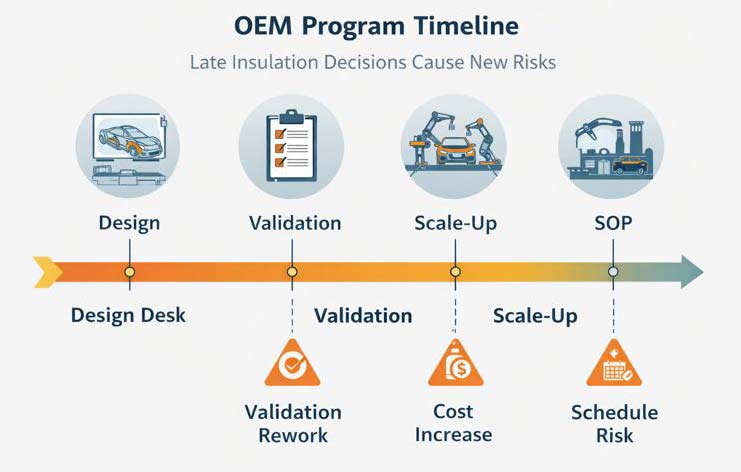
Thermal models, safety analyses, and validation results are built on earlier assumptions. Any change to insulation material, thickness, or placement alters heat behavior and safety margins. As a result, teams are forced to revisit data that was previously approved, often under severe time pressure as SOP approaches.
How Late Insulation Decisions Disrupt Validation Cycles
Late-stage insulation changes commonly trigger a chain reaction across validation activities. Thermal cycling and heat exposure tests must be repeated. Safety and compliance documentation requires updates. Components are re-validated against internal and regulatory standards, and manufacturing readiness plans must be realigned to reflect revised specifications. Each step compounds delay because validation activities are interdependent and sequential.
These disruptions typically surface close to SOP, when timelines are already compressed and flexibility is limited. Engineering, quality, and manufacturing teams are pushed into reactive execution, increasing coordination strain across OEM insulation planning.
Why do insulation changes near SOP create disproportionate risk?
Because validation, compliance, and manufacturing plans are already locked, even minor insulation changes invalidate earlier assumptions and force rework across multiple functions simultaneously.
In competitive OEM environments, these delays postpone market entry, increase launch risk, erode stakeholder confidence, and reduce program profitability. Late insulation decisions do not simply delay schedules. They destabilize them at the most critical phase of the product lifecycle.
Safety, Compliance, and Reliability Risks of Late Insulation Decisions
Perhaps the most underestimated cost of late insulation decisions is risk. Not financial risk alone, but safety, compliance, and long-term reliability risk that accumulates quietly across the program lifecycle.
Insulation plays a preventive role within engineered systems. It manages heat exposure, protects adjacent components, and creates safety margins under both normal and fault conditions. When insulation is added reactively, often in response to test failures or overheating issues, it may address the immediate symptom without resolving the underlying system behavior shaped by insulation design timing.
Why Reactive Insulation Fixes Undermine Long-Term Reliability
In EV platforms, insufficient or poorly integrated insulation can affect thermal runaway containment and heat propagation paths, directly influencing EV thermal insulation performance. Hydrogen systems, late insulation solutions may overlook prolonged exposure to temperature gradients, pressure variation, or material compatibility challenges. In defence platforms, insulation performance is often tied to survivability and mission reliability over extended service life.
Reactive insulation fixes are typically validated under limited conditions due to schedule pressure near SOP. Long-term aging, vibration exposure, and repeated thermal cycling may not be fully assessed. This creates a gap between short-term compliance and long-term reliability across insulation decisions in OEM platforms.
When insulation is treated as a last-minute correction, it functions as a patch. When integrated early through disciplined OEM insulation planning, it operates as a designed safety system that protects the platform over its full lifecycle.
Why Insulation Decisions Are Cross-Functional, Not Isolated
One reason insulation decisions are often delayed is organisational structure. Insulation does not belong neatly to a single function. It sits at the intersection of design, engineering, safety, manufacturing, and procurement, which makes ownership unclear when decisions are postponed.
How Functional Silos Delay Insulation Decisions
Mechanical design teams focus on space, mounting, and structural compatibility. Thermal engineers evaluate heat flow, exposure limits, and insulation effectiveness. Safety teams assess compliance and risk mitigation. Manufacturing teams consider assembly feasibility and repeatability, while procurement evaluates material availability, cost stability, and supplier capability. When insulation is not discussed early, each function optimises independently, creating assumptions that rarely align.

Why Late Alignment Increases Program Friction
By the time insulation becomes unavoidable, no single team owns the decision. Compromises are made under pressure, often near design freeze or SOP. Early insulation planning forces alignment by creating shared assumptions around thermal boundaries, service conditions, and lifecycle expectations. This cross-functional clarity reduces late-stage conflict, shortens integration cycles, and improves predictability as the program progresses.
Insulation decisions are not isolated technical choices. They are coordination points that shape how the entire OEM platform comes together, technically, operationally, and organisationally.
Early Insulation Discipline Versus Reactive Problem-Solving
Across OEM platforms, the difference between early insulation discipline and reactive problem-solving is structural, not philosophical. It determines how predictably a program moves from design to SOP, especially under thermal, safety, and lifecycle pressure.
- System-level integration: Insulation is selected, tested, and packaged as part of the core system architecture, not added later.
- Predictable cost behavior: Early decisions limit redesign loops and prevent cascading cost escalation across functions.
- Stable validation pathways: Thermal models, safety assumptions, and test results remain consistent through SOP.
- Reduced iteration cycles: Programs avoid repeated fixes triggered by late-stage thermal or compliance failures.
- Lower coordination burden: Engineering, quality, and manufacturing teams work from shared assumptions instead of reacting independently.
- Lifecycle-ready performance: Insulation is validated for long service life in EV, hydrogen, and defence platforms.
- Higher program confidence: Teams approach SOP with fewer unknowns and stronger technical assurance.
Reactive problem-solving follows a different pattern. Each late insulation adjustment addresses a symptom, not the system. Complexity accumulates, documentation expands, and confidence declines as programs near launch.
Early insulation discipline is not about adding effort upfront. It is about removing uncertainty before it spreads across the platform.
Why Early Insulation Decisions Protect OEM Platforms Long-Term
The hidden cost of late insulation decisions extends beyond budgets and timelines. It surfaces in validation risk, safety exposure, and long-term platform reliability. Insulation timing is a strategic engineering decision.
When addressed early, it supports predictable costs, stable schedules, and robust safety margins across the lifecycle. When delayed, it amplifies risk at the exact point OEM programs can least absorb disruption. For platforms operating in high-stakes, long-service environments, insulation cannot remain a downstream task. It must be treated as a system-level discipline, integrated from the earliest design stages.
Early insulation decisions do more than protect components. They protect the platform and the program over its entire lifecycle.
Partner with PBM Insulations early in your design cycle to engineer insulation decisions upfront, reduce lifecycle risk, and build OEM platforms ready for SOP with confidence.
Ready to Future-Proof Your Product with Insulation That Performs?
At PBM Insulations, we engineer thermal and acoustic solutions that power India’s leading OEMs. Whether you’re building the next electric vehicle, optimizing industrial machinery, or looking to enhance sustainability — we’re here to co-create with precision, trust, and performance.
Let’s turn your insulation challenges into engineered solutions.
📩 Reach out for a custom consultation
🌐 Visit us at: www.pbminsulations.com
📞 Call us: +91-7310777959
🔗 Connect with us: LinkedIn | YouTube | Instagram
Join our network for monthly insights on insulation innovation, EV breakthroughs, and industry trends. Subscribe to PBM Insulation Insights today.
“Crafting Quiet Strength Since 1993” | An IATF, ISO & Ecovadis Certified Company | Your OEM Partner in Thermal & Acoustic Innovation