
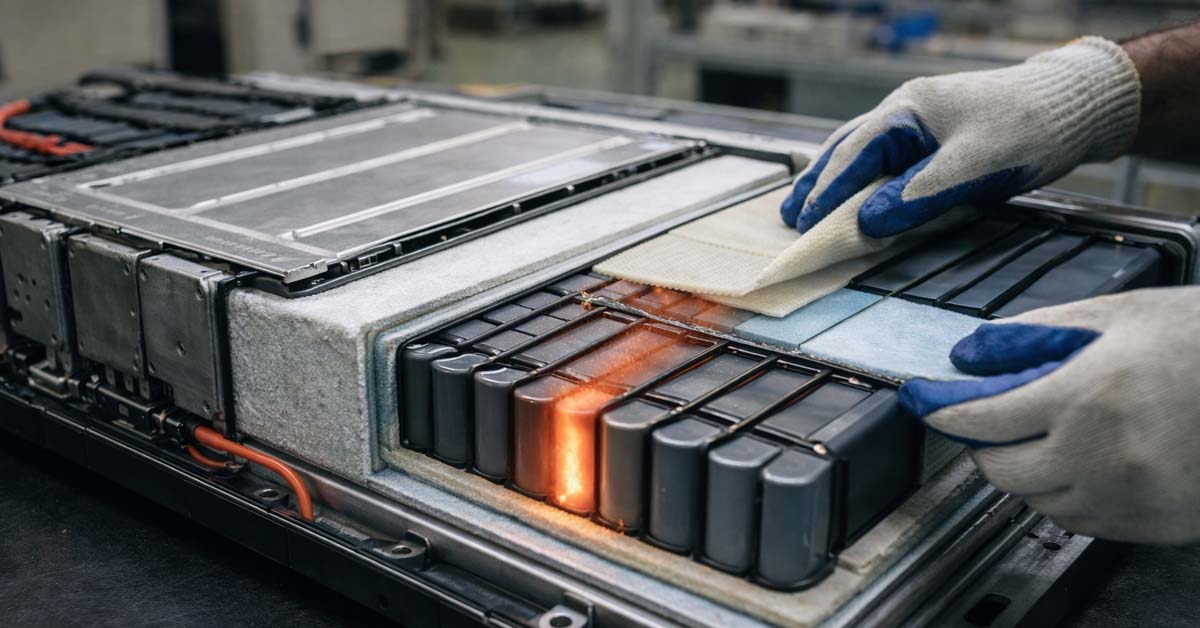
Engineering safer battery packs requires more than just high-capacity cells. Thermal runaway insulation plays a critical role in controlling rapid heat release during internal failures and preventing propagation across EV battery systems.
Welcome to a platform where we share specialized insights on high-performance insulation solutions built for modern, high-density electric vehicle battery systems. The focus is not just materials, but containment, safety, and real-world performance under stress.
Industry data shows thermal propagation is the leading cause of pack-level failures. This makes EV battery insulation and thermal runaway containment essential for extending escape time. It makes EV battery thermal management a critical design and safety requirement.
PBM Insulations works with automotive and EV OEM programs where insulation directly impacts thermal runaway containment and battery safety. Our focus is on how materials perform under failure conditions, integrate within battery packs, and deliver consistent containment at scale.
This blog explains how insulation systems work together to deliver effective EV battery thermal management and containment performance.
The Science of Thermal Runaway Insulation in EV Battery Packs
Thermal runaway insulation prevents heat propagation between cells and contains failure within a defined zone inside EV battery systems. It is a critical layer in EV battery insulation and safety validation.
Cell-to-Cell Thermal Barrier Performance
Thermal runaway containment relies on insulation that delays heat transfer between adjacent cells. This delay defines whether failure remains localized or spreads across the battery pack under stress conditions. In EV battery insulation design, this barrier performance is critical for maintaining separation between cells and modules in high-density architectures.
Material Stability Under Thermal Runaway Conditions
High temperature insulation EV materials must retain structure during failure and not degrade under extreme heat exposure. ceramic fibre insulation and aerogel insulation EV solutions maintain integrity, especially in thin-profile applications where space and thermal resistance must be balanced.
Thermal runaway insulation is evaluated on containment performance, not just temperature resistance. This directly impacts EV battery thermal management and safety validation. Where containment performance must be validated under real-world thermal stress and delivered consistently at production scale.
Primary Fire Barriers for Thermal Runaway Containment
Ceramic and silica-based materials act as primary fire barriers in thermal runaway insulation, designed to contain extreme heat and prevent propagation across EV battery systems. They are critical in EV battery insulation where failure conditions exceed standard material limits.
Ceramic Fibre Insulation for High Temperature Stability
Ceramic fibre insulation is used where high temperature insulation EV performance and direct flame resistance are required.
- Thermal endurance: Withstands direct flame exposure above 1000°C without structural collapse or thickness loss
- Dimensional stability: Retains form under prolonged thermal stress, ensuring consistent barrier performance during failure
- Chemical resistance: Stable against electrolyte leakage and corrosive gases released during cell rupture
- Low thermal conductivity: Slows heat transfer between adjacent cells, supporting thermal runaway containment
- Non-combustible behaviour: Does not ignite or contribute to flame spread within battery modules
Silica Fibre Needled Mat for Containment Performance
Silica fibre mats are used to enhance EV battery thermal management and provide dense containment layers within battery packs.
- High purity silica: Maintains non-combustible properties at temperatures exceeding 1000°C
- Binder-free construction: Eliminates smoke and toxic outgassing during thermal runaway events
- Dense fibre structure: Creates an effective thermal barrier that delays heat propagation across cells
- Mechanical strength: Withstands vibration and compression within EV battery pack environments
- Flexible integration: Can be die-cut and placed between prismatic or cylindrical cells for precise insulation
These materials form the core of thermal runaway insulation, ensuring EV battery insulation systems deliver containment performance, structural stability, and OEM-level safety validation.
Structural Integrity and Thin-Profile Thermal Runaway Insulation
Thermal runaway insulation must remain fixed and stable under real-world automotive conditions. In EV battery insulation systems, mechanical integrity ensures that containment performance is not compromised by vibration, movement, or long-term operational stress.
Mechanical Stability in EV Battery Insulation Systems
In EV battery insulation design, materials must maintain their position and structure across the vehicle lifecycle. Continuous vibration, thermal cycling, and mechanical load can create gaps if insulation is not properly supported. This directly affects thermal runaway containment, as even minor displacement can allow heat to propagate between adjacent cells and compromise safety performance.
Reinforcement Using Synthalon Felt and Wire Mesh
Structural reinforcements such as Synthalon Felt and knitted wire mesh are used to stabilize insulation layers within battery packs. Synthalon Felt provides controlled compression and cushioning, helping insulation act as a sealing layer while protecting cells. Wire mesh reinforcement ensures that fibrous materials remain fixed in place, maintaining consistent EV battery thermal management and containment performance under dynamic conditions.
How Do Specialized Materials Prevent Thermal Runaway?
Thermal runaway containment is achieved by creating thermal and physical barriers that absorb heat, delay energy transfer, and isolate failing cells. This prevents propagation across adjacent cells and ensures EV battery insulation systems limit failure to a controlled zone within the battery pack.
Structural integrity and material integration define the real-world performance of thermal runaway insulation. For OEM programs, this directly impacts EV battery insulation reliability, safety validation, and long-term containment performance.
Best Materials for Inter-Module Thermal Runaway Containment
Inter-module fire protection in EV battery insulation depends on materials that can withstand extreme temperatures and prevent heat propagation during failure events.
- Silica fibre needled mat: Provides non-combustible insulation capable of withstanding temperatures above 1000°C while maintaining structural integrity for thermal runaway containment
- Ceramic fibre insulation: Offers high temperature insulation EV performance with resistance to flame, chemical exposure, and thermal degradation
- Thermal barrier function: Creates separation between modules, limiting heat transfer and preventing propagation across battery segments
- Precision glass wool: E-Glass and C-Glass fibres enable customized fit within battery trays for consistent insulation coverage
- S.S. wool applications: Supports localized thermal isolation and acoustic dampening in high-stress areas
- Manufacturing consistency: Ensures repeatable density, thickness, and performance across OEM EV battery programs for reliable containment
These materials define inter-module thermal runaway insulation performance, directly influencing EV battery safety, containment effectiveness, and OEM validation outcomes.
Conclusion
EV battery safety depends on how effectively thermal runaway insulation controls heat propagation under failure conditions. As battery density increases, EV battery insulation must deliver consistent thermal runaway containment, not just resistance.
Materials such as ceramic fibre insulation, silica fibre mats, and aerogel insulation EV solutions enable controlled heat isolation and structural stability across battery systems. Their performance defines whether failure remains localized or spreads across modules.
For OEM programs, this is a validation requirement, not just a material choice. The right insulation approach ensures EV battery thermal management systems perform reliably under real-world conditions, supporting safety, compliance, and scalable manufacturing.
Partner with PBM Insulations for validated thermal runaway insulation solutions engineered for OEM EV battery safety, performance, and scalable manufacturing.
Ready to Future-Proof Your Product with Insulation That Performs?
At PBM Insulations, we engineer thermal and acoustic solutions that power India’s leading OEMs. Whether you’re building the next electric vehicle, optimizing industrial machinery, or looking to enhance sustainability — we’re here to co-create with precision, trust, and performance.
Let’s turn your insulation challenges into engineered solutions.
📩 Reach out for a custom consultation
🌐 Visit us at: www.pbminsulations.com
📞 Call us: +91-7310777959
🔗 Connect with us: LinkedIn | YouTube | Instagram
Join our network for monthly insights on insulation innovation, EV breakthroughs, and industry trends. Subscribe to PBM Insulation Insights today.