

The process of choosing the right insulation for a vehicle platform or system begins with prototype testing. Prototypes, of course, often perform well in a laboratory setting. They meet thermal and acoustic targets during the prototype testing phase. However, as any OEM designer understands, prototype results are often a poor indicator of how the materials being used will perform once the production process begins.
We, at PBM Insulations, have spent over three decades helping automotive and industrial OEMs create insulation systems. With manufacturing facilities in Aligarh and Vapi, in-house testing labs, and partnerships with OEMs such as Tata, Hyundai, Mahindra, and Ashok Leyland, we understand what large-scale programs demand.
Insulation selection is still often based on prototype validation rather than production readiness throughout the industry. This creates risk when programs move from engineering approval to full manufacturing volumes.
Before awarding long-term OEM insulation programs, procurement and engineering teams must evaluate manufacturing repeatability, certification frameworks, and supply infrastructure, not just material performance. This is particularly true for thermal insulation for OEMs operating at production scale.
Prototype Validation vs Production Stability in OEM Insulation Programs
Prototype validation testing is used to validate insulation performance. However, the requirement for consistent insulation performance is significant throughout the process of large-scale manufacturing of thermal insulation for OEMs
Why Prototype Success Fails in High-Volume Insulation Manufacturing
Prototype samples are typically produced under controlled conditions. Engineers often monitor material selection, processing, and testing closely to make sure the insulation performs as expected during validation.
The challenge appears when production scales. Moving from small batches to large volumes introduces variations in fiber density, bonding, and material handling. These differences may slightly alter thermal or acoustic behavior across production runs.
For OEM manufacturers, even small variations are critical. Insulation components play an essential role in engine heat management, EV battery management, and EV battery thermal protection requirements, as well as cabin noise reduction. If the manufacturing process is not able to deliver consistent results, the risk increases significantly during full-scale production.
Therefore, the OEMs are now looking for suppliers based on the stability of the manufacturing process as well as engineering validation.
Bridging Engineering Validation and Production-Scale Insulation Manufacturing
For the production process, a structured manufacturing process is required. The stability of the process is based on the standardization of the process, raw materials, and equipment calibration. This makes manufacturing repeatability a core qualification metric for OEM supplier selection.
At PBM Insulations, our main aim is the manufacturing repeatability of the insulation components using our production infrastructure. Our facilities are well equipped with needling and texturizing equipment, profile cutting, lamination, and moulding with continuous fiber technology.
When combined with internal testing and design validation, this strategy facilitates the smooth transition of the OEM partner from prototype qualification to production program stability.
Key takeaway: For OEMs, the success of an insulation program hinges upon the ability of the manufacturing systems to deliver consistent performance across every batch of production, not just prototypes.
Manufacturing Repeatability as the Core Qualification Factor for OEM Insulation Suppliers
In the modern automotive and EV industry, insulation material manufacturers are not only judged by the quality of their material, but also by manufacturing repeatability.
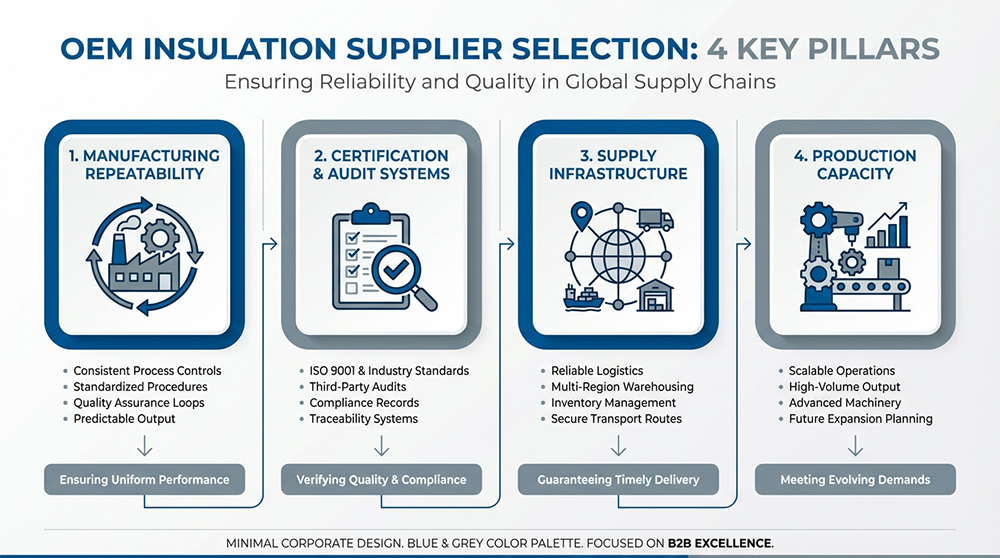
Process Control and Standardised Production in Insulation Manufacturing
Manufacturing repeatability begins with structured production processes. Insulation components must maintain the same thermal and acoustic properties regardless of production volume. Achieving this requires controlled raw material handling, calibrated machinery, and clearly defined quality checkpoints.
OEM programs often run for several years, with thousands of vehicles produced every month. During this time, insulation components must deliver stable performance across every production cycle. Even minor inconsistencies can disrupt assembly operations or affect system performance.
At PBM Insulations, we support repeatability through an integrated engineering and manufacturing approach. Our design and validation process includes tools such as SolidWorks for component modeling, Prolog thermal simulation for heat shield analysis, and Simu-Therm for material optimization. These systems allow us to evaluate insulation performance before production begins. This ensures a smoother transition from engineering validation to manufacturing.
Why Zero-PPM Quality Matters in Automotive and EV Insulation Manufacturing
Automotive OEMs operate with extremely strict quality standards. The expectation of zero-PPM defect rates means insulation suppliers have to maintain consistent manufacturing accuracy across each and every batch.This is especially critical in EV insulation manufacturing, where thermal stability directly impacts battery safety.
Through in-house testing, material validation, and process monitoring, manufacturers can maintain stable production output. They can also reduce the risk of defects in large-scale programs.
Key takeaway: When insulation suppliers demonstrate manufacturing repeatability, OEM teams gain confidence. They know that validated performance will remain stable throughout the entire lifecycle of the program.
Certification, Audit Transparency, and Compliance in OEM Insulation Supply Chains
For any automotive insulation supplier, certification and audit readiness are non-negotiable for OEM qualification. They show that a manufacturer of insulation adheres to disciplined procedures and uniformity of quality.

Why Certifications Matter for Automotive and EV Insulation Suppliers
The certifications assist OEMs in determining the process capabilities of a supplier to the global standards in manufacturing. Standards such as IATF and ISO indicate that the systems of production are guided by documented quality management practice and the framework of continuous improvements.
In the case of insulation manufacturers, these certifications ensure that the sourcing of materials, manufacturing processes, and quality inspections are within specific controlled parameters. This is particularly critical to the automotive, EVs, and defense industry. In these sectors, thermal protection components are required to be reliable throughout the long lifecycle of a product.
In addition to control over processes, certification systems are also an indicator of organizational discipline. They are a pointer that a manufacturer invests in quality assurance systems. Training of employees and transparency of operation are factors that mitigate risk in long-term OEM programs.
Audit Transparency and In-House Testing in Insulation Manufacturing Infrastructure
Facility audit and technical review are also common practices among OEMs when they award significant programs. These tests examine production systems, documentation, and the ability to test products.
The manufacturers who have testing infrastructure in-house are able to show performance data in a better way. Thermal testing devices, controlled heating conditions, and material validation tests aid in ensuring that insulation products work per the reality before mass production.
Key takeaway: Open audit practices and transparent certification systems ensure that OEM team members are convinced that insulation vendors are sufficiently disciplined in their operations. This discipline is necessary to sustain stable manufacturing relationships.
Supply Infrastructure and Capacity Planning for Long-Term OEM Insulation Programs
The finest insulation materials cannot sustain OEM programs unless they have a good manufacturing capacity, logistics support, and a clear supply infrastructure.
- Multi-Facility Manufacturing Capacity for Insulation Suppliers. The presence of more than one production facility contributes to the minimization of supply risk. It also enables manufacturers to scale production as more OEM programs are introduced. Plants distributed also facilitate continuity of production in the face of fluctuation of demand.
- Vertical Integration and Raw Material Control in Insulation Manufacturing. Internal manufacturing will enhance the control of raw materials and manufacturing. This enables insulation suppliers to have a uniform quality of different batches of production.
- Regional Warehousing and Logistics for OEM Insulation Supply. Well-placed warehouses are used to assist in supporting shorter delivery times. In the case of OEMs that have just-in-time production systems, effective logistics is very important in ensuring that supply is continuous.
- Automation and Advanced Equipment in Insulation Manufacturing. High-technology manufacturing equipment, like automatic cutting, laminating, and moulding lines, is used to ensure consistency in insulation properties. They also meet large-scale manufacturing demands.
- Supply Chain Transparency in OEM RFQ Evaluation for Insulation Suppliers. Through effective communication of production capacity, sourcing of materials, and lead times, the OEM procurement teams can test the stability of the supply in the long run when doing RFQ analysis.
Key takeaway: A good supply infrastructure will keep the insulation programs constant when the volumes of production increase. This enables OEMs not to experience any kind of disruption when there is a long run in the manufacturing cycles.
Conclusion
When it comes to choosing an insulation supplier for long-term OEM insulation programs, there are several factors that need to be taken into account, aside from the performance of the materials. Prototype validation is definitely a crucial part of early performance checking; however, to maintain the desired performance on a bigger scale, long-running OEM programs require manufacturing solutions.
Nowadays, there is a rising trend among the procurement and engineering groups of OEMs to prefer insulation suppliers who have established manufacturing processes, certification systems, and supply chains.
It is recommended that you initiate discussions with PBM early in the OEM RFQ process to ensure scalable insulation manufacturing solutions and validated performance.
Ready to Future-Proof Your Product with Insulation That Performs?
At PBM Insulations, we engineer thermal and acoustic solutions that power India’s leading OEMs. Whether you’re building the next electric vehicle, optimizing industrial machinery, or looking to enhance sustainability — we’re here to co-create with precision, trust, and performance.
Let’s turn your insulation challenges into engineered solutions.
📩 Reach out for a custom consultation
🌐 Visit us at: www.pbminsulations.com
📞 Call us: +91-7310777959
🔗 Connect with us: LinkedIn | YouTube | Instagram
Join our network for monthly insights on insulation innovation, EV breakthroughs, and industry trends. Subscribe to PBM Insulation Insights today.
“Crafting Quiet Strength Since 1993” | An IATF, ISO & Ecovadis Certified Company | Your OEM Partner in Thermal & Acoustic Innovation