
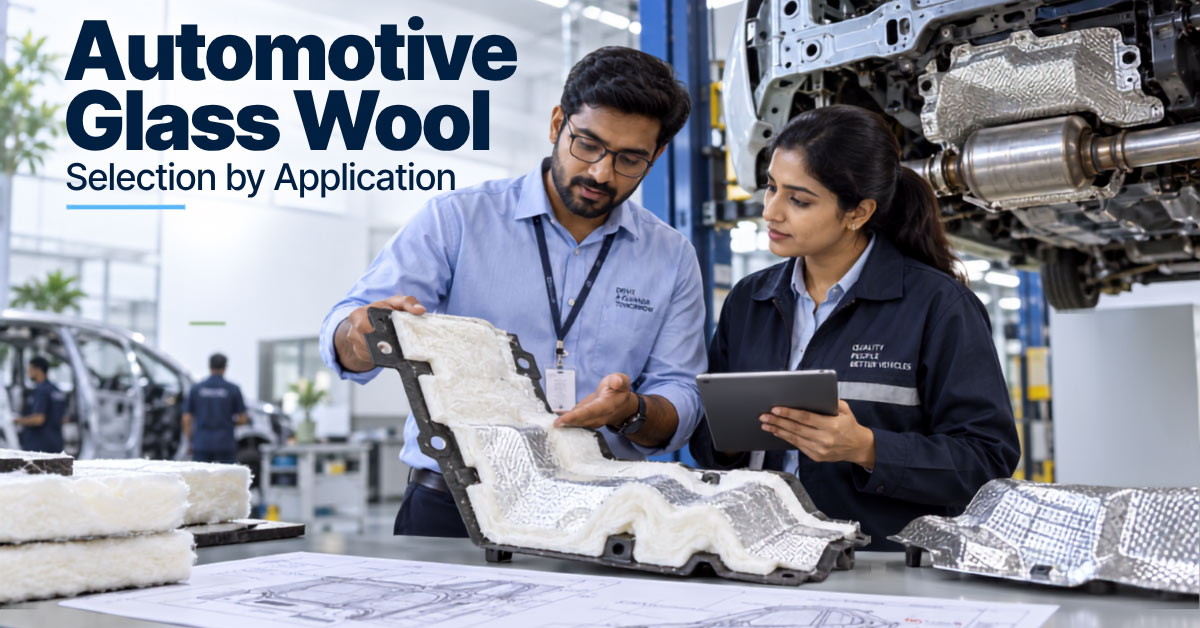
Thermal management can account for 10–15% of vehicle energy consumption, making insulation a critical engineering consideration. Yet while thermal insulation is extensively studied in buildings, its role in automotive applications remains comparatively underexplored
This challenge is increasing as OEMs design lighter and more compact vehicle platforms. Engine bays, underbody zones, firewalls, floors, and cabin areas all operate under different thermal, acoustic, mechanical, and space constraints.
PBM’s automotive work involves matching insulation performance with application conditions, component geometry, fitment, and production consistency. That experience becomes especially important when glass wool grades must perform across different thermal and acoustic zones within the same vehicle.
This article explains how glass wool insulation should be selected for automotive applications based on grade, density, thickness, format, thermal exposure, acoustic performance, fitment, and operating conditions.
High-Performance Glass Wool Solutions for Exhaust and Underbody Shielding
Exhaust and underbody zones combine high heat, vibration, moisture, road debris, and tight packaging, so glass wool selection must begin with actual operating conditions.
Automotive glass wool is selected by matching grade, density, thickness, and format to temperature exposure, available space, acoustic requirement, durability, and fitment. The right insulation mat is therefore application-led, not temperature-rating-led.
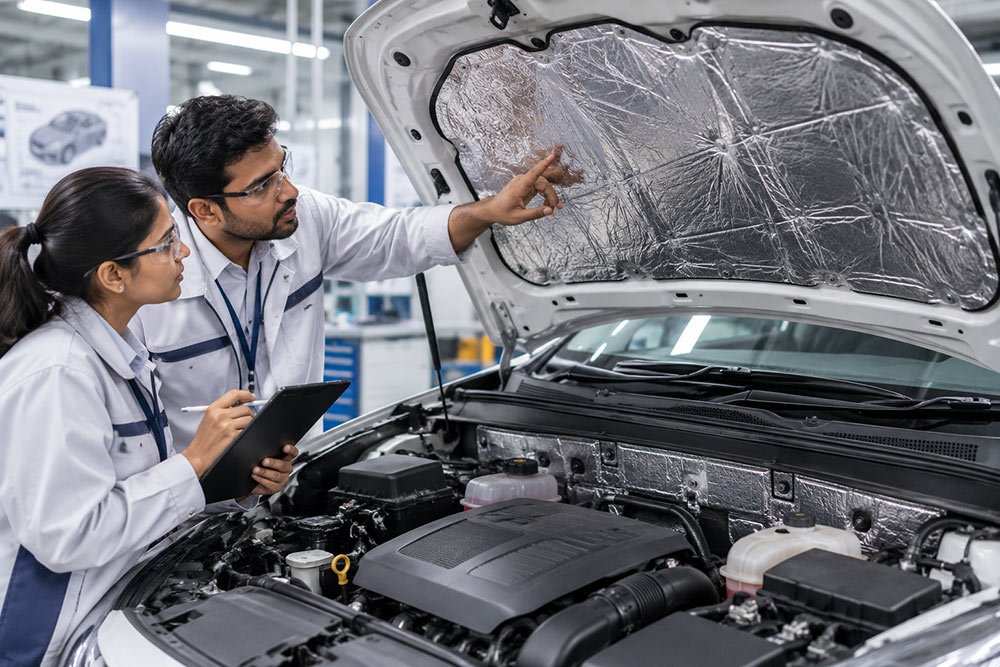
E-Glass Fibre for Thermal Control
E-Glass fibre is commonly considered where thermal insulation must be achieved without adding unnecessary weight or bulk. Around exhaust systems, catalytic converters, and nearby chassis components, engineers must assess not only heat exposure but also available clearance, required thickness, compression, and the final shape of the insulation.
In our experience, fitment often becomes the deciding factor after the thermal requirement is clear. A material may meet the expected temperature range, but if its density or thickness does not suit the available space, the design can become difficult to install or repeat consistently in production.
C-Glass Fibre for Harsh Underbody Conditions
Underbody insulation faces a different set of demands. Moisture, road salt, chemical exposure, vibration, and repeated thermal cycling can affect long-term material performance. C-Glass fibre may be considered where chemical resistance and durability are important alongside thermal protection.
For OEM programmes, this means grade selection must be evaluated together with density, thickness, profile geometry, and installation conditions. PBM can support this through material selection, profile cutting, customised formats, and in-house validation before the insulation moves into scalable automotive production.
The right underbody insulation therefore balances thermal performance, durability, fitment, weight, and production repeatability rather than optimising any one property in isolation.
Glass Wool for Sound Deadening and Cabin Refinement
Achieving a quiet and refined cabin requires acoustic insulation that can absorb airborne noise, control vibration, and fit within restricted door, floor, roof, and firewall spaces.
Synthalon Felt for Mechanical Vibration Suppression
Integrating engineered felt materials into interior trim allows automotive manufacturers to target structural vibrations that transfer from the chassis into the passenger cabin. Where vibration control is the primary requirement, Synthalon Felt can complement glass wool insulation within the overall acoustic system.
- High Acoustic Absorption: Synthalon Felt helps absorb high-frequency airborne noise within door panels, roof liners, and other cabin zones.
- Mechanical Panel Cushioning: Its flexible structure cushions adjoining panels and helps reduce squeaks and vibration caused by continuous vehicle movement.
Material choice still depends on available thickness, component geometry, weight, fitment, and the specific acoustic requirement of the vehicle zone.
Glass Wool and Knitted Wire Mesh Integration
In high-stress areas exposed to both vibration and acoustic leakage, glass wool insulation can be combined with knitted wire mesh to improve retention and mechanical durability.
- Acoustic Performance: Glass wool helps absorb engine, transmission, and road noise before it reaches the passenger compartment.
- Enhanced Matrix Durability: Knitted wire mesh can reinforce the insulation mat where repeated vibration or movement could affect long-term stability.
For OEM applications, density, thickness, format, and installation conditions should be evaluated together. Correctly specified automotive glass wool can support cabin refinement while maintaining fitment and repeatability in production.
Safeguarding the Engine Bay and Cabin Firewall
The engine bay insulation around the firewall must manage concentrated heat, acoustic transfer, limited space, and prolonged thermal exposure without compromising adjacent components or cabin comfort.
Silica Fibre Mat as a High-Temperature Barrier
High-purity silica fibre mats are suited to high-temperature engine bay and firewall applications where conventional thermal insulation may not provide sufficient protection. Their flexible, non-woven structure allows them to conform around complex components while creating an effective barrier between intense heat sources and sensitive vehicle systems.
Mechanically needled silica mats can withstand temperatures exceeding 1000°C and are produced without chemical binders. This helps minimise smoke, odour, and outgassing under severe thermal exposure. For OEM applications, thickness, density, available packaging space, component geometry, and fitment should still be evaluated alongside temperature capability before finalising the insulation format.
What is the most effective thermal barrier material for engine bays?
High-purity silica fibre mats and ceramic fibre insulation are commonly used for extreme-temperature engine bay applications because they combine high heat resistance, low thermal conductivity, flexibility, and durability in areas exposed to concentrated thermal loads.
For automotive glass wool applications near the firewall, material selection should therefore consider whether the operating temperature remains within the required range or demands a higher-temperature insulation material. This prevents over-specification while maintaining thermal protection, fitment, and production consistency.
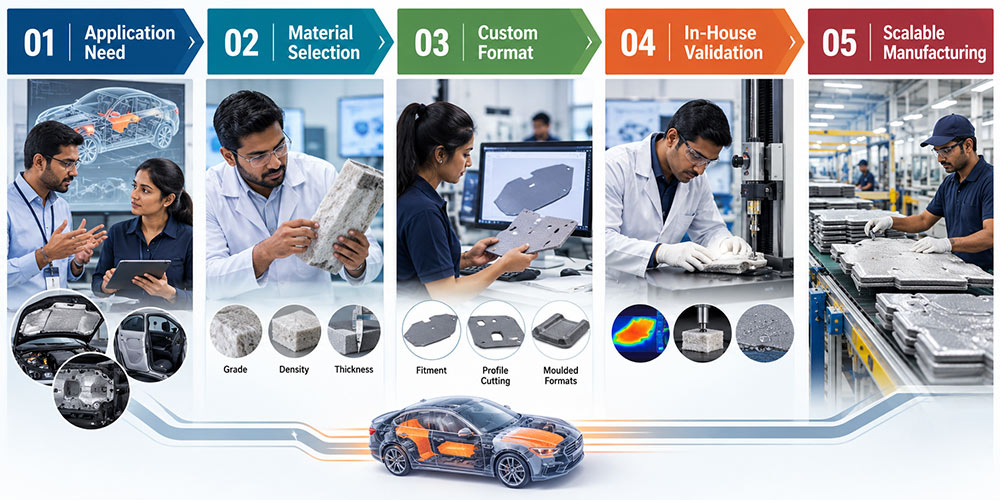
Custom Glass Wool Engineering for Automotive OEMs
Automotive OEM programmes require insulation materials to meet precise dimensions, repeatable fitment, defined performance targets, and scalable production requirements across large vehicle platforms.
- Tailored Glass Fibre Densities: E-Glass and C-Glass formats can be selected by density, thickness, packaging space, and vehicle geometry to support thermal performance and consistent fitment.
- Custom Insulation Formats: Profile cutting and moulded insulation mats help match complex chassis, firewall, exhaust, and underbody geometries while improving installation consistency during production.
- In-House Validation: Material and format choices can be assessed against thermal behaviour, dimensional stability, and application requirements before approval for scaled manufacturing.
- Automotive Quality Systems: PBM operates under IATF 16949 and ISO 9001 quality systems, supporting process control, repeatability, and documented manufacturing discipline for automotive programmes.
- Scalable Manufacturing: Once the required glass wool insulation grade, density, thickness, and format are validated, PBM can support repeatable production for OEM and Tier supplier applications.
Custom engineering therefore ensures that car insulation is not selected as a standard material alone, but developed around fitment, performance, durability, and manufacturing consistency.
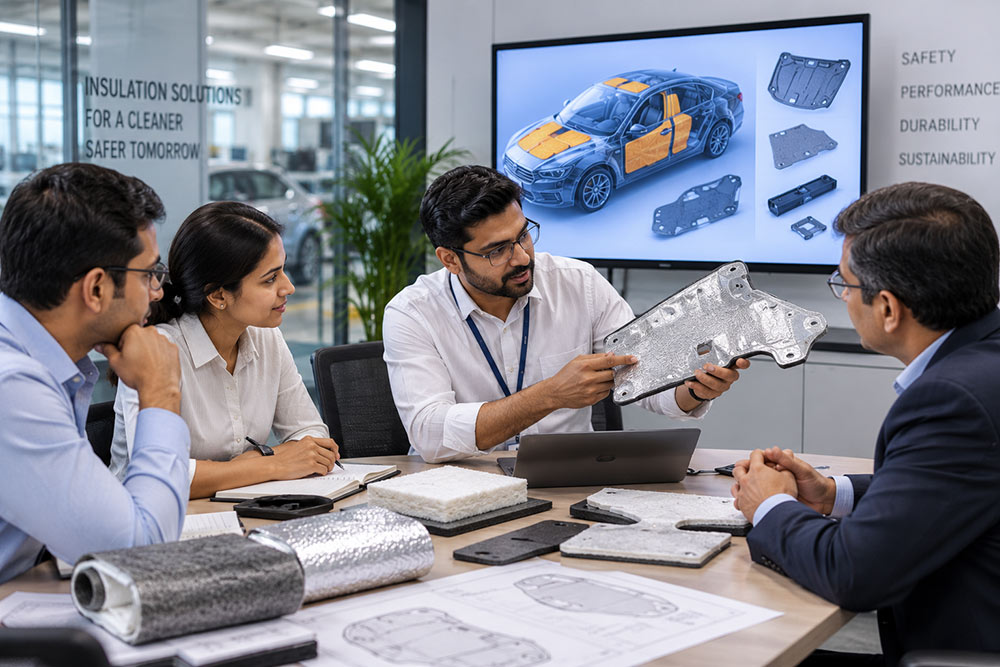
Conclusion
Selecting the right automotive glass wool is critical to maintaining thermal control, acoustic performance, component protection, and passenger comfort across modern vehicle platforms.
The final choice should reflect more than temperature resistance. Grade, density, thickness, fitment, operating conditions, and application geometry all influence how effectively glass wool insulation performs in real vehicle environments.
For OEM and Tier supplier programmes, PBM supports material selection with custom insulation mats, profile cutting, moulded formats, in-house validation, and scalable manufacturing aligned with automotive production requirements.
Contact PBM’s technical team to discuss car insulation and engine insulation requirements and develop application-specific glass wool solutions for your automotive programme.
Ready to Future-Proof Your Product with Insulation That Performs?
At PBM Insulations, we engineer thermal and acoustic solutions that power India’s leading OEMs. Whether you’re building the next electric vehicle, optimizing industrial machinery, or looking to enhance sustainability — we’re here to co-create with precision, trust, and performance.
Let’s turn your insulation challenges into engineered solutions.
📩 Reach out for a custom consultation
🌐 Visit us at: www.pbminsulations.com
📞 Call us: +91-7310777959
🔗 Connect with us: LinkedIn | YouTube | Instagram
Join our network for monthly insights on insulation innovation, EV breakthroughs, and industry trends. Subscribe to PBM Insulation Insights today.
“Crafting Quiet Strength Since 1993” | An IATF, ISO & Ecovadis Certified Company | Your OEM Partner in Thermal & Acoustic Innovation