
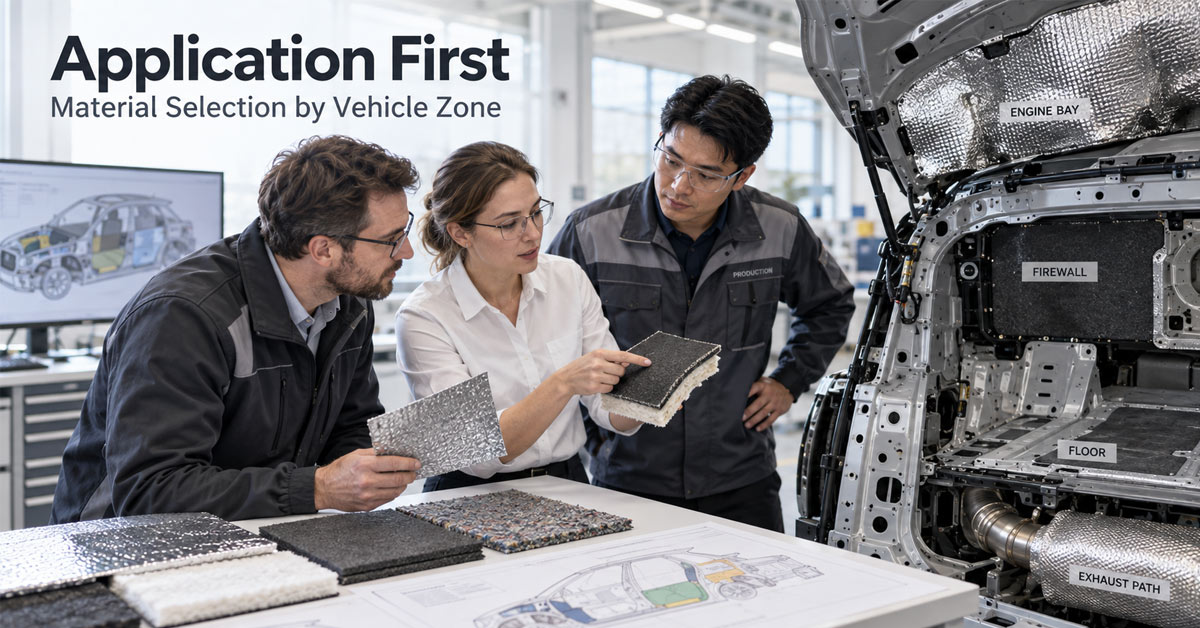
A material can pass the temperature requirement and still fail the vehicle application. That is the friction engineers face with automotive insulation materials. A grade may survive the heat, yet become unsuitable because the available gap is too narrow, vibration affects its shape, or the installed format cannot remain consistent in service.
A datasheet measures the material. It does not measure the vehicle zone around it. Clearance, weight targets, moisture exposure, vibration, geometry and production-line installation can all change whether a technically compliant material is actually suitable.
At PBM, material selection starts with the application because that is where engineering compromises become visible. Across automotive programmes, the recurring questions are practical: Will it fit? Will it stay in place? Will it survive vibration? Can the same format be produced consistently at scale?
In this edition, we examine how vehicle zones, operating conditions, material trade-offs, packaging constraints and production requirements should guide insulation selection before the final specification is approved.
Material Properties Alone Cannot Determine Application Suitability
Property data filters the options. It does not make the decision. A material can meet every published figure and still be unsuitable once the vehicle zone is assessed properly.
Application suitability means evaluating an insulation material against the actual vehicle zone, including thermal exposure, available space, vibration, acoustic demand, moisture, weight, fitment and installation conditions. A material is suitable only when these requirements are validated before final specification.
The Limits of Temperature Rating in Material Selection
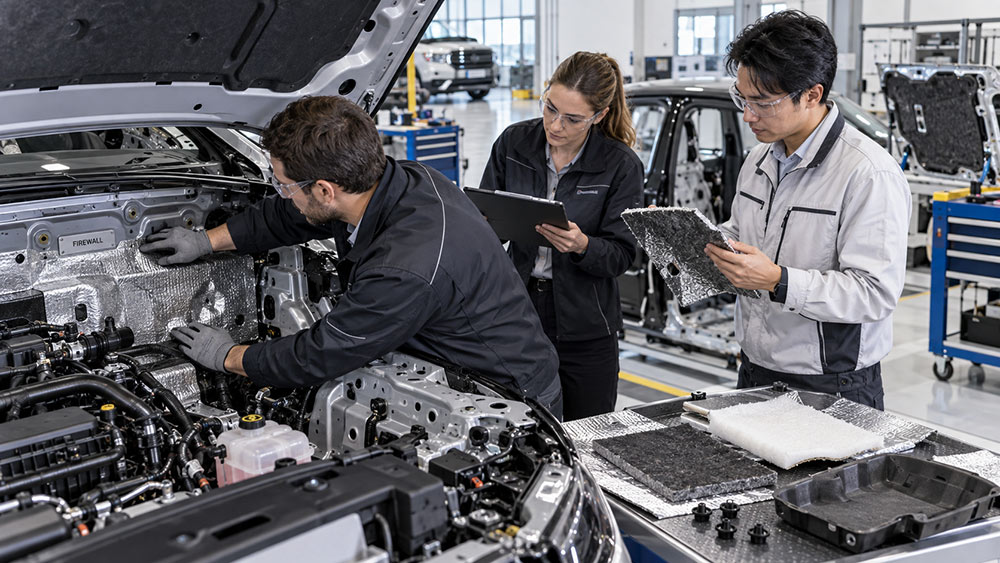
A temperature rating answers one question. It does not state how much thickness is needed to reach that rating inside the gap available, or what that thickness adds in weight.
Temperature capability is only one part of insulation material selection. A higher-rated material is not automatically the better choice if it adds unnecessary thickness, weight or rigidity. The correct material is the one that meets the measured thermal exposure while still fitting the packaging, durability and installation requirements of that vehicle zone.
Application Constraints That Affect Material Suitability
The expensive problems appear late. The part will not conform to the bracket geometry. The cut edge scatters fibre. The material holds moisture in an underbody position. Each one passes the datasheet test.
Then there is installation. If a format cannot be fitted the same way on every unit, the line absorbs the variation. Fitment is where most of these problems concentrate. These are application conditions, not material defects, and they are not visible on a property sheet. They surface during trials, when the programme has less room to change direction.
Suitability is a judgement about the zone, not the material. The property sheet narrows the field. The application decides what actually works in production.
Vehicle Zones Create Different Insulation Requirements
One vehicle contains several operating environments. Exhaust zones, engine bays, floors and cabin areas expose insulation to different combinations of heat, vibration, moisture, noise and packaging limits.
High-Heat Zones: Engine Bay, Exhaust and Firewall
These zones combine concentrated heat with restricted space. The material must maintain performance through continuous exposure, repeated thermal cycles and vehicle movement.
- Thermal Endurance: Continuous heat demands stable performance across long operating cycles, not just resistance to a peak temperature.
- Tight Geometry: Insulation must conform around brackets, pipes and restricted clearances without compromising fitment or installation.
- Thermal Cycling: Repeated heating, cooling and vibration test dimensional stability throughout the vehicle’s service life.
Cabin, Floor and Underbody Zones Require Different Material Priorities
Here, thermal load may reduce, while acoustic control, environmental exposure, weight and available thickness become more important.
- Acoustic Control: Sound absorption and vibration damping can become primary requirements, particularly across cabin and floor applications.
- Exposure Resistance: Underbody locations face moisture, salt and road debris, making durability under environmental exposure critical.
- Space and Weight: Packaging limits and vehicle weight targets determine how much insulation can realistically be used.
A material suitable around an exhaust path may be unnecessarily heavy, rigid or thermally excessive for a cabin application.
Effective automotive insulation selection begins with the vehicle zone. Vehicle insulation materials should then be compared only against the thermal, acoustic, packaging and durability demands of that specific application.”
Comparing Automotive Insulation Materials Across Applications
Insulation material comparison only becomes useful when the application criteria are defined first. Automotive insulation materials should then be assessed against thermal exposure, acoustic need, packaging, weight, fitment, durability and environmental conditions.
Evaluating Material Trade-Offs Against Application Requirements
Material selection is shaped by thermal exposure, acoustic need, thickness, weight, fitment, durability, environmental exposure and production consistency.
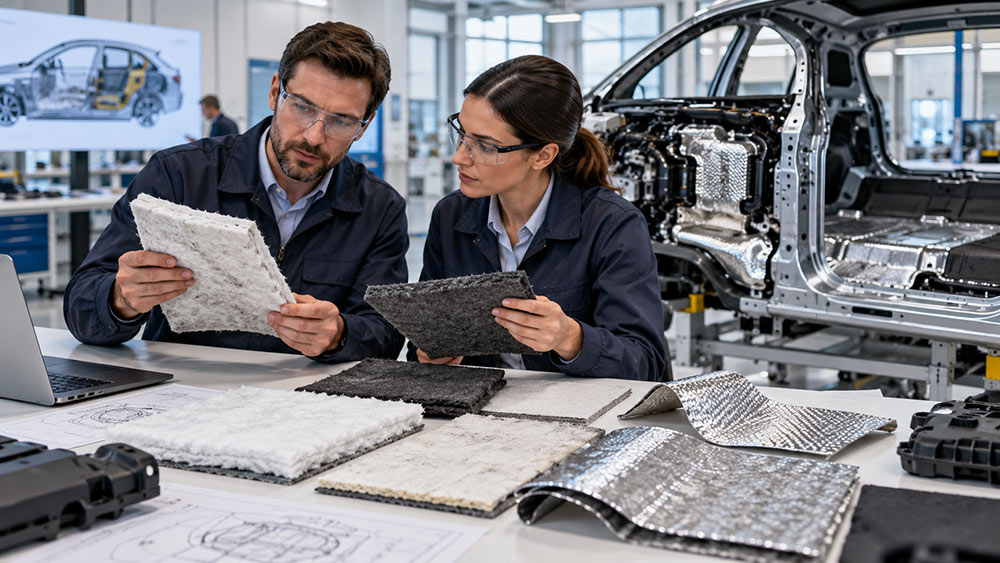
Once these are clear, materials become application-specific options. Supermat grades address thermal demand, Synthalon Felt supports sound and vibration control, ceramic fibre handles sustained heat, aerogel suits tight spaces, and flexible heat shields protect complex hot zones. No material is the default choice.
Which Automotive Insulation Material Suits a Specific Vehicle Application?
No single automotive insulation material suits every application. The right choice depends on the thermal exposure, acoustic demand, available thickness, weight target, fitment geometry and environmental conditions of that vehicle zone, confirmed through validation before the specification is finalised.
Comparison narrows the field. It does not close the decision. What remains is proving the shortlisted format in the actual application.
From Material Shortlist to Validated Production Specification
A shortlist is not a specification. The final decision depends on whether the selected material can fit, perform, be customised and remain consistent at production scale.
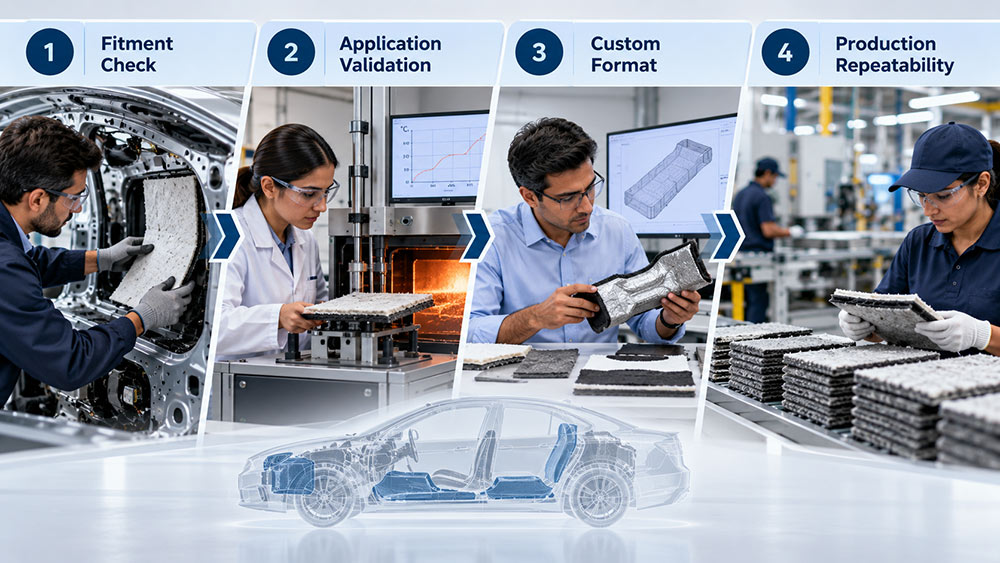
- Fitment Check: The format is checked against actual component geometry, clearance and assembly access. A material that works on a drawing but cannot be installed repeatably must be reconsidered.
- Application Validation: Performance is assessed against the conditions the vehicle zone imposes. PBM supports in-house material testing and application validation so potential issues can be identified before approval.
- Custom Format: Density, thickness, profile cutting and moulded formats are adapted to the component requirement. Prototyping helps confirm the selected format before scale production.
- Production Repeatability: The selected format must retain its dimensions, fitment and performance across repeated batches and programme volumes under controlled manufacturing systems.
Selection ends here, not at the shortlist. The material that reaches specification is the one proven against both the application requirement and the production requirement.
Conclusion
Wrong material selection often becomes visible late in the programme, during trial builds, validation or line installation, when changing direction becomes more difficult.
The sequence that avoids this is straightforward. Assess the zone. Define the requirement. Compare formats against that requirement. Confirm fitment. Validate under real conditions. Then specify, and hold that specification through production.
Automotive insulation materials are not selected from a catalogue. They are selected from the application, and proven before they reach the bill of materials. That is the difference between a compliant material and a suitable one.
Contact PBM’s technical team to discuss your vehicle application before finalising the insulation material specification for your next programme.
Ready to Future-Proof Your Product with Insulation That Performs?
At PBM Insulations, we engineer thermal and acoustic solutions that power India’s leading OEMs. Whether you’re building the next electric vehicle, optimizing industrial machinery, or looking to enhance sustainability — we’re here to co-create with precision, trust, and performance.
Let’s turn your insulation challenges into engineered solutions.
📩 Reach out for a custom consultation
🌐 Visit us at: www.pbminsulations.com
📞 Call us: +91-7310777959
🔗 Connect with us: LinkedIn | YouTube | Instagram
Join our network for monthly insights on insulation innovation, EV breakthroughs, and industry trends. Subscribe to PBM Insulation Insights today.
“Crafting Quiet Strength Since 1993” | An IATF, ISO & Ecovadis Certified Company | Your OEM Partner in Thermal & Acoustic Innovation