
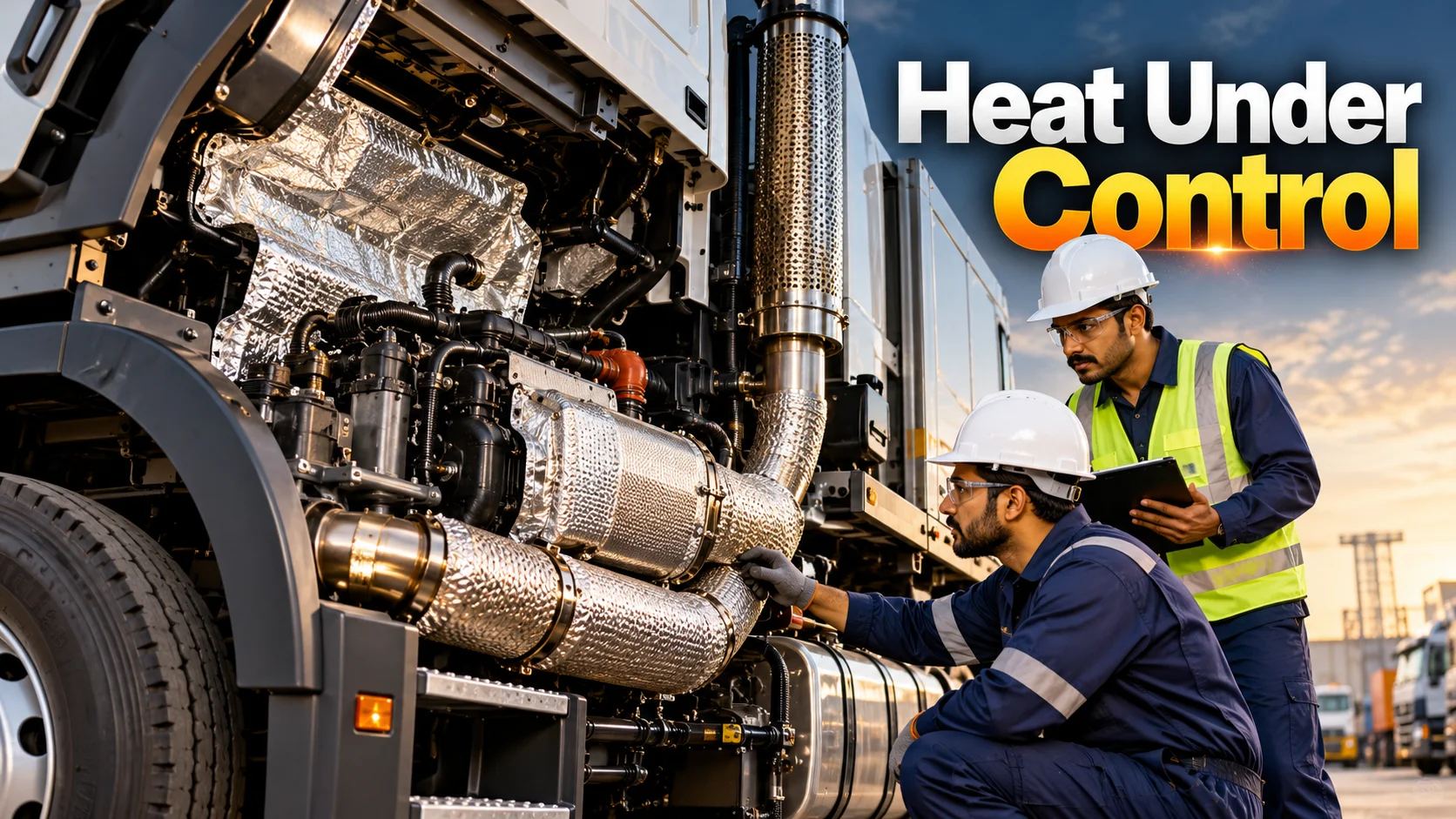
Heavy-duty vehicles often run for long hours under sustained heat, vibration, and restricted airflow. In these conditions, heavy-duty vehicle insulation becomes critical because unmanaged engine bay and exhaust heat can accelerate component wear, increase cabin heat, and raise maintenance demands across the fleet.
The challenge has grown as modern commercial vehicles use tighter packaging, turbocharged engines, and advanced after-treatment systems. Tighter packaging concentrates heat around manifolds, exhaust lines, catalysts, and nearby components, making conventional insulation formats less effective in demanding heavy-duty operating conditions.
At PBM, we treat these applications as engineering problems rather than material-selection exercises. Our team uses thermal simulation, in-house testing, prototyping, and application validation to assess how insulation will perform under actual heat, vibration, clearance, and fitment conditions.
This article examines how glass wool, ceramic fibre, heat shields, and flexible insulation formats help manage heat, reduce noise, protect nearby components, and improve durability across heavy-duty engine bay and exhaust applications.
Thermal Shielding Strategies for Heavy-Duty Exhaust Systems
Heavy-duty exhaust systems create concentrated radiant heat around manifolds, turbochargers, pipes, and after-treatment units. Effective thermal shielding must control this heat while remaining stable under vibration, restricted clearances, and long operating cycles.
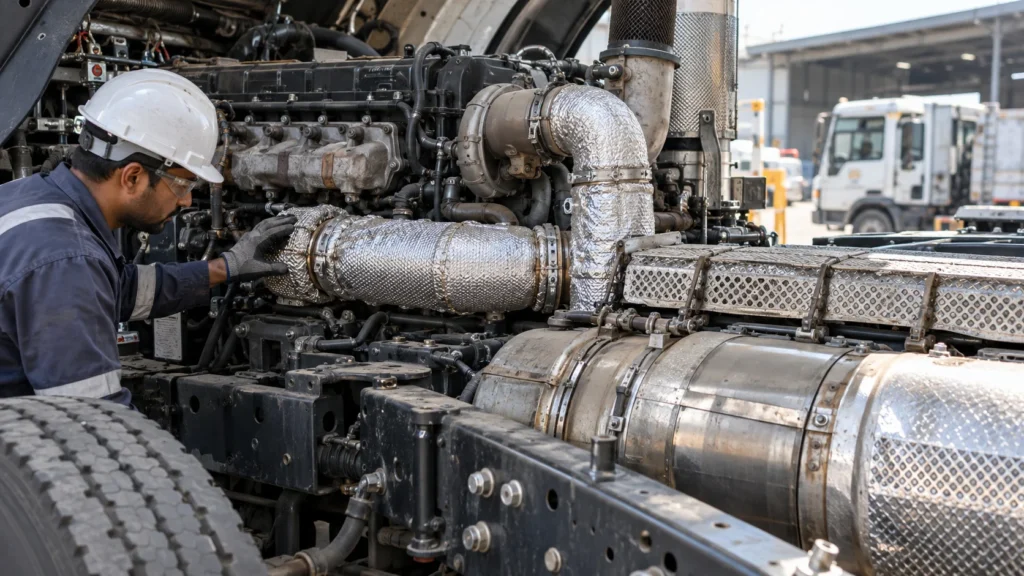
An exhaust heat shield for heavy-duty systems should reduce radiant heat, withstand continuous high temperatures, and remain stable under vibration. Glass wool, E-Glass, and C-Glass fibre systems can protect nearby components across exhaust and after-treatment zones.
E-Glass and C-Glass Fibre Applications in Exhaust Shields
E-Glass fibre can support exhaust shielding where mechanical strength, dimensional stability, and resistance to demanding operating conditions are important. Its structure makes it suitable for insulation assemblies exposed to vibration and repeated thermal cycling.
C-Glass fibre can complement these systems in areas exposed to moisture and corrosive conditions. Material selection should still depend on temperature, geometry, vibration, chemical exposure, and the required shield construction rather than fibre type alone.
Mitigating Radiative Heat with Glass Wool Insulation
Glass wool insulation helps reduce heat transfer from exhaust pipes, manifolds, and after-treatment zones by creating a thermal barrier between the heat source and nearby vehicle components.
For heavy-duty applications, density, thickness, clearance, and installation format matter as much as the material itself. The insulation must remain stable during long operating cycles while limiting heat exposure to surrounding components, wiring, panels, and other temperature-sensitive systems.
From our experience, exhaust shielding performs best when material selection starts with the actual heat source, clearance, vibration, and duty cycle. The right insulation system is engineered around the application rather than selected from temperature rating alone.
Engine Bay Isolation and Acoustic Noise Suppression
Engine bay insulation must manage more than noise. Heavy-duty compartments combine vibration, heat, panel movement, and long operating hours, so acoustic materials must retain their position and performance throughout repeated duty cycles.
Synthalon Felt for Mechanical Vibration Cushioning
Synthalon Felt supports acoustic insulation and vibration absorption in demanding vehicle environments, particularly where flexible material is needed between panels and adjoining surfaces.
- Airborne Noise Absorption: The dense felt structure helps absorb engine and transmission noise before it reaches adjoining cabin areas.
- Vibration Cushioning: Its flexible construction helps reduce vibration transfer between contacting panels and surrounding vehicle structures.
- Flexible Fitment: Felt conforms easily to tight or irregular spaces, supporting acoustic control where rigid insulation is harder to position.
Knitted Wire Mesh Integration for High-Stress Compartments
Stainless steel wire mesh adds resilience and energy absorption where insulation assemblies face continuous vibration and mechanical movement. PBM identifies flexibility, malleability, and energy absorption among its core wire-mesh properties.
- Mechanical Reinforcement: Wire mesh can support fibrous insulation where vibration may otherwise affect material position or integrity.
- Vibration Management: Its resilient structure helps absorb mechanical energy in high-movement engine bay applications.
- Assembly Stability: Mesh reinforcement can help insulation remain secure around complex geometries and mechanically demanding zones.
Acoustic control in heavy-duty engine bays cannot be separated from vibration and fitment. In practice, lasting performance depends on selecting an insulation assembly that remains stable throughout the vehicle’s operating cycle.
High-Temperature Protection with Silica and Ceramic Fibres
High-temperature zones around engine compartments and firewalls need insulation that can limit heat transfer while remaining stable through repeated thermal exposure. Material choice must also account for space, fitment, flexibility, and the temperature range of the application.
Ceramic Fibre Blanket and Silica Material Performance Under Thermal Stress
Ceramic fibre blankets provide lightweight, flexible thermal insulation where the material must conform around complex shapes and withstand repeated high-temperature exposure. Their low thermal mass also makes them useful where rapid heat exposure and tight installation geometry are part of the operating environment.
High-silica materials add thermal stability and flexibility in demanding heat zones. PBM’s confirmed portfolio identifies High Silica Cloth for applications requiring low shrinkage and reliable performance under elevated temperatures. The final format should therefore be selected around actual temperature, geometry, and installation requirements.
What is the most effective heat shield material for engine bays?
The most effective heat shield material depends on operating temperature, exposure time, available space, and fitment. Ceramic fibre and high-silica materials are strong options for high-temperature engine bay zones where thermal stability and flexible installation are required.
High-temperature firewall protection is ultimately about containment. When the insulation remains stable around complex shapes and repeated heat exposure, it helps protect adjacent structures and keeps extreme heat from migrating into more sensitive vehicle zones.
Custom Heavy-Duty Vehicle Insulation for OEM Applications
Heavy-duty vehicle insulation often needs to be engineered around restricted clearances, complex shapes, vibration, and repeated thermal exposure. For OEM programs, material choice must therefore connect directly with fitment, validation, and repeatable production.
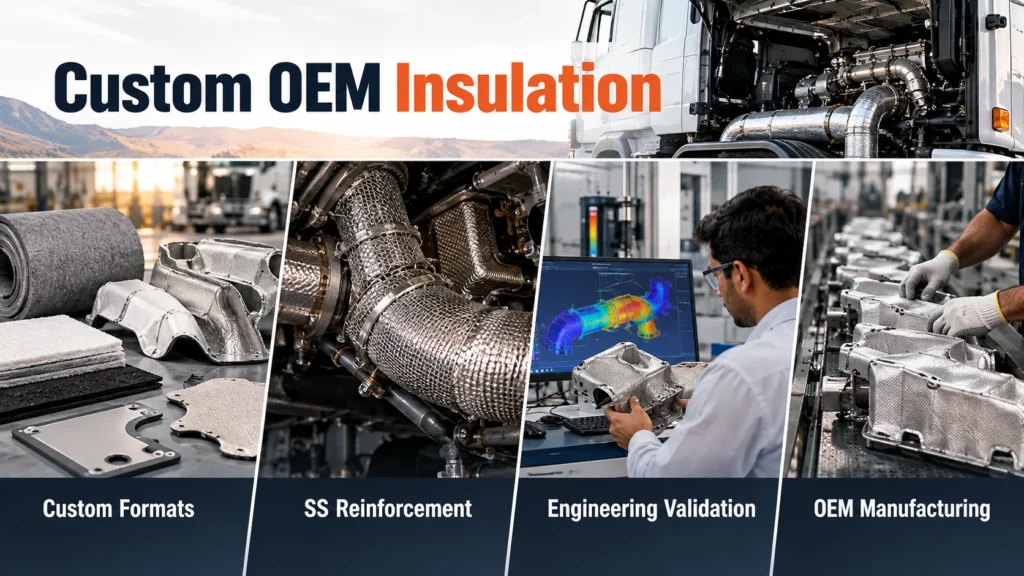
- Application-Specific Formats: PBM can develop profile-cut, moulded, laminated, and flexible insulation formats to suit engine bay, exhaust, and other confined high-heat zones.
- Stainless Steel Reinforcement: SS wool and wire-mesh products add resilience, vibration absorption, and mechanical support where insulation assemblies face continuous movement and demanding operating conditions.
- Engineering and Validation: Thermal simulation, material selection tools, prototyping, and in-house testing help assess whether the selected multi-layer insulation format can perform under the intended application conditions.
- Controlled OEM Manufacturing: PBM operates under IATF 16949 and ISO 9001 quality systems, supporting process consistency and repeatable manufacturing for automotive OEM requirements.
For OEM teams, the real value lies in converting a heat problem into a validated component that fits correctly, performs consistently, and can be manufactured repeatedly at program scale.
Conclusion
Heavy-duty vehicle insulation plays a direct role in controlling engine bay and exhaust heat, protecting nearby components, and supporting long-term vehicle reliability. The right insulation system must perform under sustained heat, vibration, restricted clearances, and demanding duty cycles.
Ceramic fibre insulation, glass wool, flexible heat shields, and reinforced formats each serve different thermal and mechanical requirements. Their effectiveness depends on selecting the right material and construction for the actual application.
For OEMs, the priority is not just heat resistance. It is a validated insulation component that fits, performs, and remains consistent at production scale.
Contact PBM’s engineering team for application-specific heavy-duty vehicle insulation engineered for engine bay, exhaust, and high-temperature OEM requirements.