
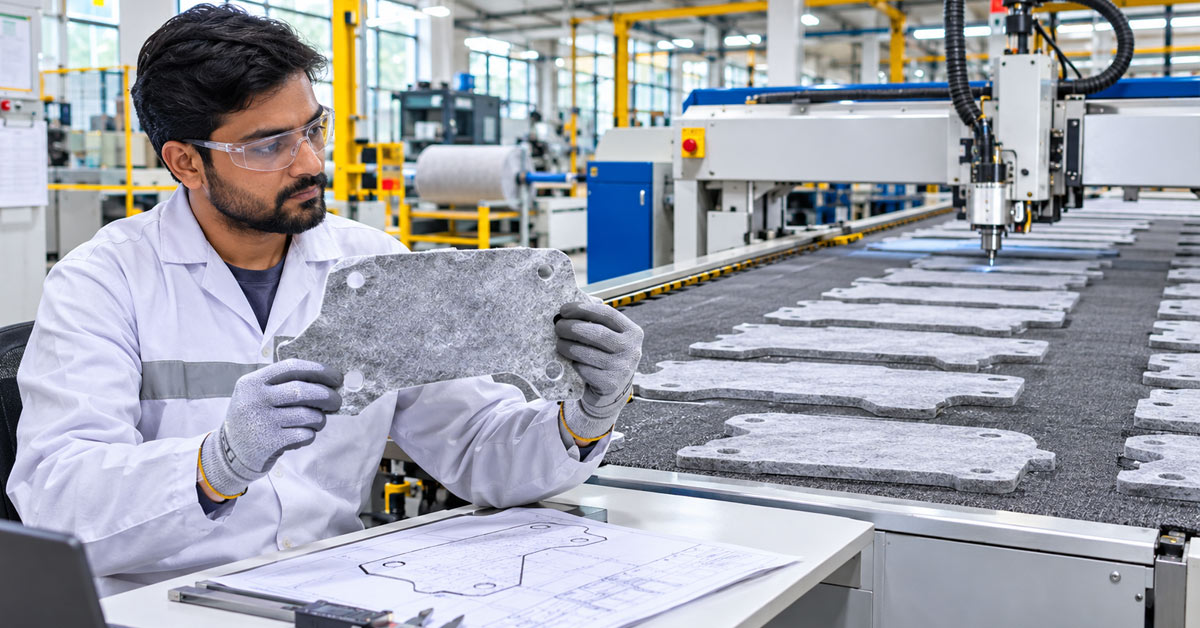
An insulation component clears prototype approval. Fitment is signed off, thermal targets are met and the programme moves toward SOP. Then the first serial batches arrive. Thickness drifts by a fraction. A profile edge sits slightly off. The part that passed as a sample now struggles on the assembly line. This is where OEM insulation manufacturing is truly tested.
At PBM, we have moved insulation components from approved samples into repeat OEM supply for more than three decades, across two-wheeler, four-wheeler, commercial vehicle and EV programmes. The pattern is consistent. Programmes rarely struggle because the design was wrong. They struggle because the process behind the design was never built to repeat it.
Most supplier evaluations focus on whether a component can be made. Far fewer examine whether it can be made the same way across thousands of units, multiple batches and a production life measured in years.
Repeatability is a manufacturing discipline. It is built through process control, validation and capacity planning. This article examines what it takes to carry an approved insulation design into stable serial production.
Prototype Approval Is Only the Starting Point in OEM Insulation Manufacturing
An approved prototype confirms that a design meets its requirements. It does not confirm that the process behind it can deliver the same result, unit after unit, at production volume.
OEM insulation manufacturing is the production of thermal and acoustic insulation components to an approved OEM specification, with consistent dimensions, material properties and fitment maintained across every batch through serial production.
Production Feasibility Beyond the Approved Sample
A prototype is often built under close supervision. Material is selected with care. Cutting and forming are adjusted until the part fits. That level of attention does not scale on its own.
Production feasibility asks a harder question. Can the same tolerances hold when tooling runs continuously, raw material lots change and output rises? Fibre insulation adds its own variables. Density, loft and thickness respond directly to process settings. If those settings are not fixed, the approved part becomes a moving target.
Batch Variation and Its Impact on OEM Assembly
Small deviations rarely stay small on an OEM line. A mat that is slightly thicker may not seat inside its cavity. A density shift can change thermal or acoustic behaviour with no visible sign. A profile that drifts can stop a component from clearing adjacent parts.
Each of these shows up as an incoming rejection, a rework loop or a line stoppage. The cost lands on the OEM. The cause sits inside the supplier’s process.
The answer is not more inspection at the end of the line. It is process control at every stage, so that each unit is made the same way as the one approved.
Insulation Process Control That Turns Specifications into Repeatable Components
Repeatability is designed into the process, not inspected in afterwards. Each manufacturing stage must hold the specification without depending on individual operator judgement.
Core Manufacturing Processes Behind Consistent Output
At PBM, insulation process control is built around automated and controlled production lines. Each one addresses a specific source of variation in the finished component.
- Automated Needling: Controls fibre entanglement through the mat, keeping density and thickness consistent from roll to roll.
- Auto Profile Cutting: Holds component profiles to the approved geometry, so edges and cut-outs match the drawing batch after batch.
- Continuous Fibre Moulding: Forms preformed shapes with repeatable dimensions for confined and curved installations.
- Lamination: Bonds foil, cloth and mat layers in a consistent build-up for multi-layer insulation components.
Automotive Insulation Components Built Under Controlled Processes
The same process discipline applies across formats. This range reflects what controlled manufacturing must support within a single OEM programme.
- Supermat ECR, S and HS: Fiberglass needled mats for exhaust, engine bay and other high-temperature zones.
- Flexible Heat Shields: Shaped thermal protection built to fit complex geometries and tight packaging spaces.
- Custom-Moulded Components: Preformed parts made to OEM drawings for specific vehicle and equipment architectures.
Process control holds only when every stage is verified. Without validation, even a controlled process remains an assumption. That is where quality assurance takes over.
Insulation Quality Assurance Before Components Enter Serial Production
Quality assurance confirms what process control intends. It turns a stable process into evidence an OEM can review before committing serial production volumes to a supplier.
Quality Checkpoints Every OEM Programme Requires
Serial-ready insulation depends on a set of essential checkpoints. These include incoming material checks, in-process inspection and dimensional verification before components enter regular OEM supply. Each one catches variation at a different point in production.
Laboratory testing adds material-level evidence. At PBM’s in-house lab, muffle furnace testing covers loss on ignition, thermal resistance and shrinkage, while oven-based analysis measures moisture and solid content. This work runs within IATF 16949 and ISO 9001 certified quality systems. Upstream, PBM uses SolidWorks for component design, Prolog for thermal simulation and Simu-Therm for heat-shield material selection, supporting engineering decisions before production.
What Should OEMs Verify Before Awarding Serial Production Business?
OEMs should verify process capability for the specific component, inspection and dimensional records from pilot batches, laboratory evidence on material behaviour, traceability from raw material to dispatch and confirmed capacity for planned volumes. Together, these show whether a supplier can repeat an approved part, not just produce it once.
A supplier that can show this evidence has moved beyond making a component. It has shown that it can keep making it.
Scalable Production and Supply Continuity for Long-Term OEM Programmes
Consistency at pilot volumes is only half the requirement. OEM programmes need the same consistency as volumes rise and production runs extend across several years.
- Process Standardisation: Fixed parameters for needling, cutting, moulding and lamination keep output stable as volume grows. Scale should change quantity, not the part.
- Capacity Readiness: Production capacity must be confirmed before ramp-up, not discovered during it. Headroom protects quality when schedules tighten.
- Production Planning: Output aligned to OEM call-offs avoids rushed runs, which is where deviations usually begin.
- Multi-Facility Manufacturing: Manufacturing across Aligarh and Vapi spreads production capability and reduces dependence on a single site.
- Regional Warehousing: Warehouses in Chennai and Pune keep stock closer to OEM plants, protecting delivery timelines.
When repeatable manufacturing meets planned capacity, supply becomes predictable. That predictability is what an OEM is really buying when it awards a long-term insulation programme.
Conclusion
An approved prototype marks the point where production risk begins, not where it ends. The gap between a passing sample and a stable serial part is closed by manufacturing discipline, not by the design alone.
Production-ready OEM insulation manufacturing combines controlled processes, verified quality checkpoints, laboratory validation and capacity planned for the full programme life. When these are in place, components arrive the same way every time, and supply holds through every production cycle.
Moving an approved insulation component into serial production? Talk to PBM about custom insulation manufacturing built for your programme volumes.