
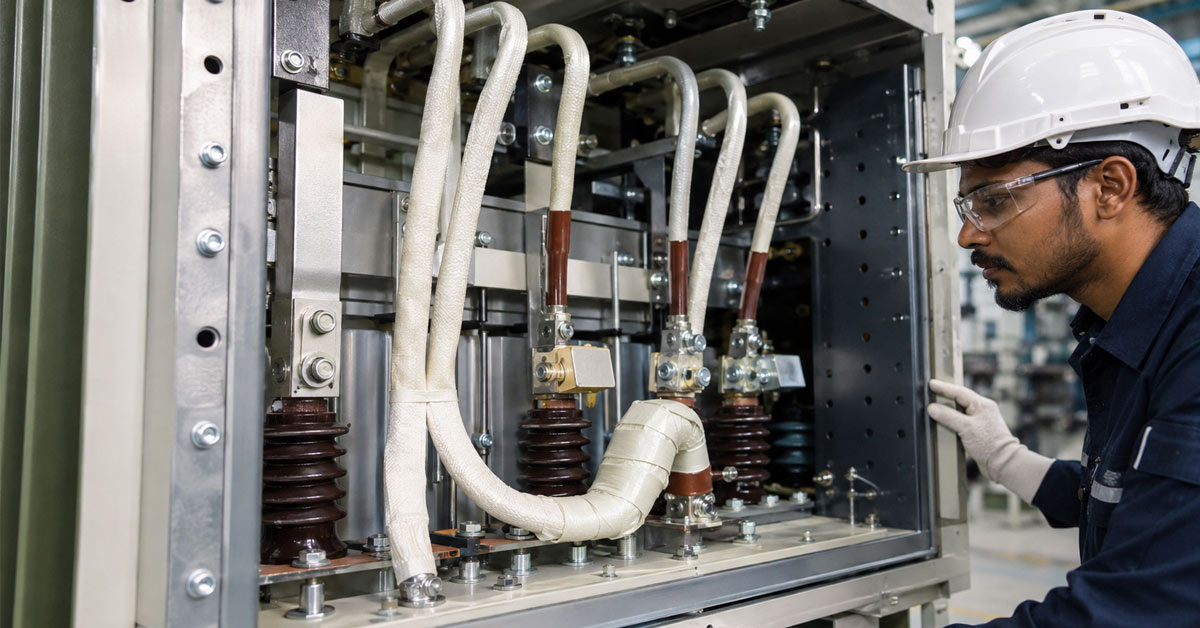
A standard fiberglass sleeve may fit perfectly on a straight conductor, yet bunch or shift at the bend where protection matters most. CIGRE’s international transformer reliability survey analysed 964 major failures across 58 utilities in 21 countries, with dielectric failures identified as the most significant failure mode.
Against that reliability backdrop, insulation material alone is not enough. The format must also remain secure around the specific zone it protects. Sleeves provide continuous conductor coverage, while fiberglass tapes conform around terminations, connections, and irregular geometries.
PBM brings 30+ years of insulation manufacturing experience to these application-specific requirements. Our certified manufacturing systems support custom sizing, material selection, validation, and repeatable production for OEM programs.
In this article, we explore how fiberglass sleeves and tapes protect critical electrical zones and why correct sizing and fitment matter in service. It is particularly relevant for electrical OEMs, engineers, and procurement teams specifying multi-layer insulation for dependable equipment protection.
Fiberglass Sleeves and Tapes for Electrical Equipment Protection
Sleeves and tapes are not interchangeable. Each protects a different zone inside electrical equipment and addresses a different mechanical demand, including coverage, wrapping, abrasion resistance, and secure fitment.
Fiberglass sleeves and tapes provide flexible cable insulation for conductors, bends, terminations, and connection zones. Sleeves provide continuous conductor coverage, while fiberglass tape conforms around irregular shapes. Their abrasion resistance and flexibility help maintain protection where rigid insulation formats may not fit securely.
Critical Electrical Zones Requiring Insulation Protection
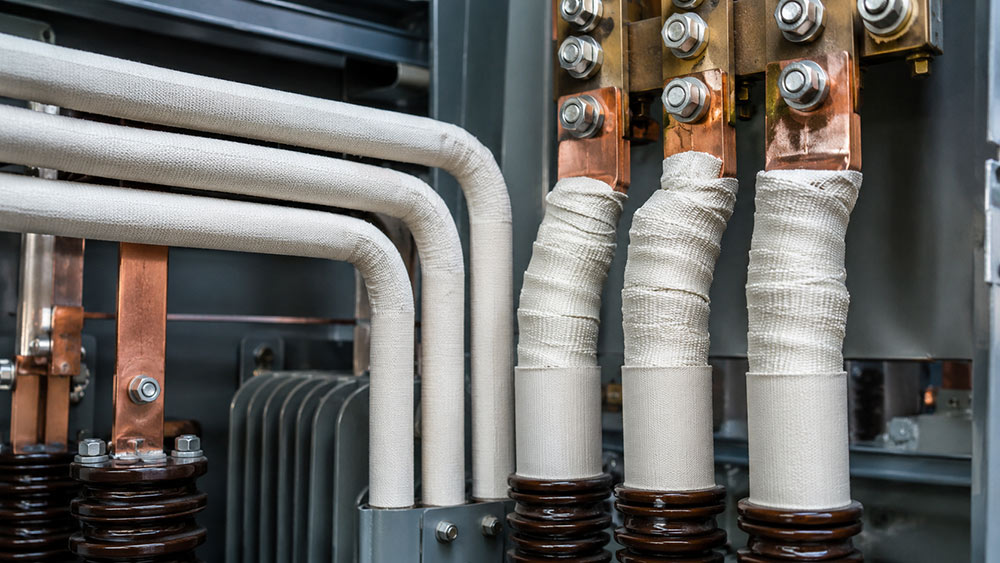
Conductors and cable runs need continuous, abrasion-resistant coverage that moves with the routing without wearing through at contact points. Terminations and connection zones need wrapped protection that conforms to irregular shapes where a rigid format may not fit securely.
Bends, junctions, and tight internal spaces also need insulation flexible enough to conform without gapping. Fiberglass sleeves slide over conductors to provide uniform coverage, while fiberglass tape wraps shapes and terminations that sleeves cannot easily cover.
Fiberglass Properties for Cable Insulation and Protection
Fiberglass sleeves in our portfolio provide electrical insulation, abrasion resistance, and coverage suited to cable management applications. Fiberglass tape is flexible, stretch-resistant, and abrasion-resistant, making it suitable for wrapping and insulation duties.
Fiberglass suits these zones because its textile format can conform around bends and terminations while resisting abrasion at contact points. This helps maintain protection where conductors route through confined equipment interiors and where secure coverage is harder to achieve.
Matched to the protection zone rather than selected only from a standard size chart, sleeves and tapes help protect the areas where electrical equipment is most vulnerable to wear and exposure.
Sizing and Fitment for Electrical Insulation Sleeves
A sleeve or tape that does not fit securely cannot provide consistent protection. Oversized formats can shift, while undersized formats may remain under stress. Correct sizing helps insulation stay positioned through vibration, thermal movement, and repeated service conditions.
Fitment as an Engineering Requirement
Fitment must reflect the actual conductor diameter, termination shape, and routing geometry. Treating sizing as an approximation can create movement, tension, or gaps at the same zones the insulation is intended to protect.
- Oversized sleeves: Excess clearance can allow the sleeve to migrate or bunch along the conductor, reducing consistent coverage around bends and contact zones.
- Undersized sleeves: Excessive tension can place unnecessary stress on the sleeve, affecting coverage and increasing the risk of damage during service.
- Incorrect tape application: Inadequate width or overlap can create gaps around terminations and irregular shapes as the assembly experiences movement.
Application-Specific Sizing for Protection Integrity
Material grade alone does not determine insulation performance. The selected sleeve or tape must also remain correctly positioned around the protected zone throughout equipment operation.
- Conductor diameter: Sleeve dimensions should correspond closely with the diameter and configuration of the conductor being protected.
- Termination geometry: Tape width and wrapping format should accommodate edges, connections, and irregular profiles without leaving exposed areas.
- Routing conditions: Bends, confined spaces, and potential contact points should influence the insulation format and sizing selected for the application.
Sizing and fitment therefore belong within the insulation specification itself. Matching the format to the equipment helps maintain continuous protection rather than relying on standard stock to suit every application.
Performance Requirements for Fiberglass Sleeves and Tapes
Choosing the right fiberglass sleeve or tape requires more than matching dimensions. Electrical OEMs must also consider abrasion resistant insulation, flexibility, routing conditions, and the type of protection required at each equipment zone.
Matching Material Format to Operating Conditions
Fiberglass sleeves are suited to conductors and cable runs that need continuous electrical insulation and abrasion protection. Their textile construction allows them to follow routed sections while maintaining coverage around bends and confined spaces.
Fiberglass tape is better suited to terminations, connections, and irregular shapes where wrapping provides more controlled coverage. Its flexible, stretch-resistant construction allows it to conform around areas that may be difficult to protect with a sleeve alone.
What should OEMs evaluate when selecting fiberglass sleeves and tapes?
OEMs should evaluate conductor geometry, abrasion exposure, routing conditions, required coverage, and whether the protection zone needs continuous sleeving or wrapped insulation. These factors help determine the most suitable fiberglass format before sizing and production requirements are finalised.
The strongest specification therefore combines material properties with application conditions. When the sleeve or tape format is selected around the actual protection zone, electrical insulation becomes easier to fit, validate, and reproduce consistently across the equipment program.
Application-Specific Fiberglass Sleeves and Tapes from PBM
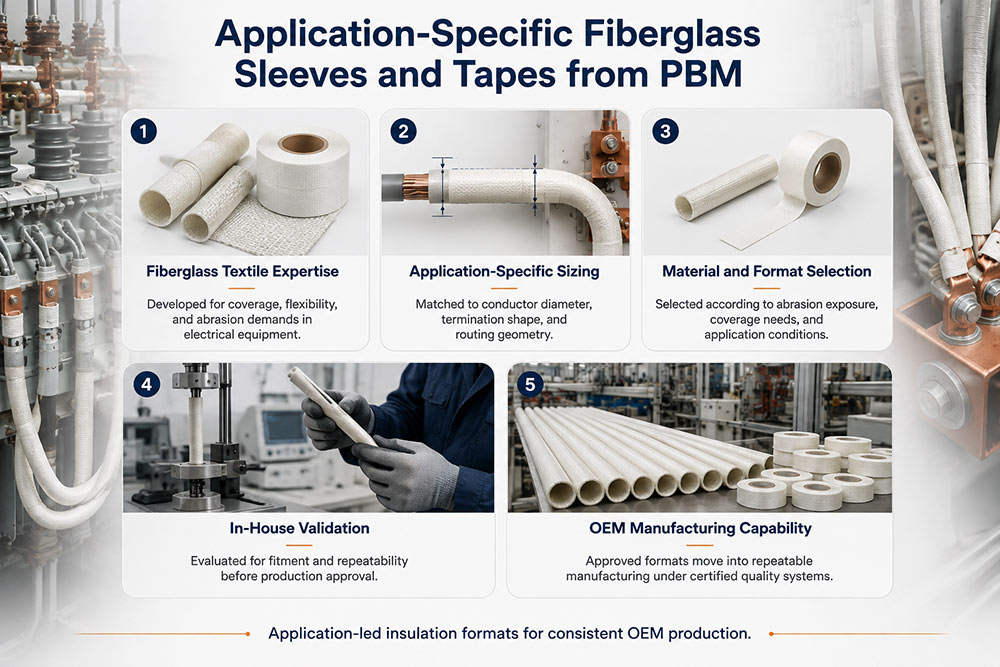
Supplying fiberglass sleeves and tapes for electrical equipment requires more than selecting a standard size. PBM matches each format to the application, protection zone, equipment geometry, and production requirement.
- Fiberglass textile expertise: Sleeves, tapes, and woven formats are developed for the coverage, flexibility, and abrasion demands of electrical equipment.
- Application-specific sizing: Electrical insulation sleeves are matched to conductor diameter, termination shape, routing geometry, and the protection zone they must cover.
- Material and format selection: Sleeve construction or fiberglass tape format is selected according to abrasion exposure, coverage requirements, and application conditions.
- In-house validation: Custom formats can be evaluated against application requirements before approval, helping establish fitment and repeatability before production.
- OEM manufacturing capability: Approved designs move into repeatable manufacturing under PBM’s IATF 16949 and ISO 9001 certified quality systems.
This application-led process keeps the insulation tied to the equipment rather than a generic size chart. It turns fiberglass sleeves and tapes into engineered protection formats that can be produced consistently across an OEM program.
Conclusion
In electrical equipment, reliable protection depends on more than insulation material alone. Fiberglass sleeves and tapes must match the conductor, termination, routing geometry, and abrasion conditions they are expected to withstand.
Correct sizing and secure fitment help maintain coverage across bends, contact points, and connection zones where movement and wear can weaken protection over time.
With 30+ years of insulation manufacturing experience and certified quality systems, PBM supports electrical OEMs with application-specific fiberglass sleeves and tapes engineered for consistent, repeatable performance.
Contact PBM to discuss custom fiberglass sleeves and tapes for your electrical equipment requirements.
Ready to Future-Proof Your Product with Insulation That Performs?
At PBM Insulations, we engineer thermal and acoustic solutions that power India’s leading OEMs. Whether you’re building the next electric vehicle, optimizing industrial machinery, or looking to enhance sustainability — we’re here to co-create with precision, trust, and performance.
Let’s turn your insulation challenges into engineered solutions.
📩 Reach out for a custom consultation
🌐 Visit us at: www.pbminsulations.com
📞 Call us: +91-7310777959
🔗 Connect with us: LinkedIn | YouTube | Instagram
Join our network for monthly insights on insulation innovation, EV breakthroughs, and industry trends. Subscribe to PBM Insulation Insights today.
“Crafting Quiet Strength Since 1993” | An IATF, ISO & Ecovadis Certified Company | Your OEM Partner in Thermal & Acoustic Innovation