
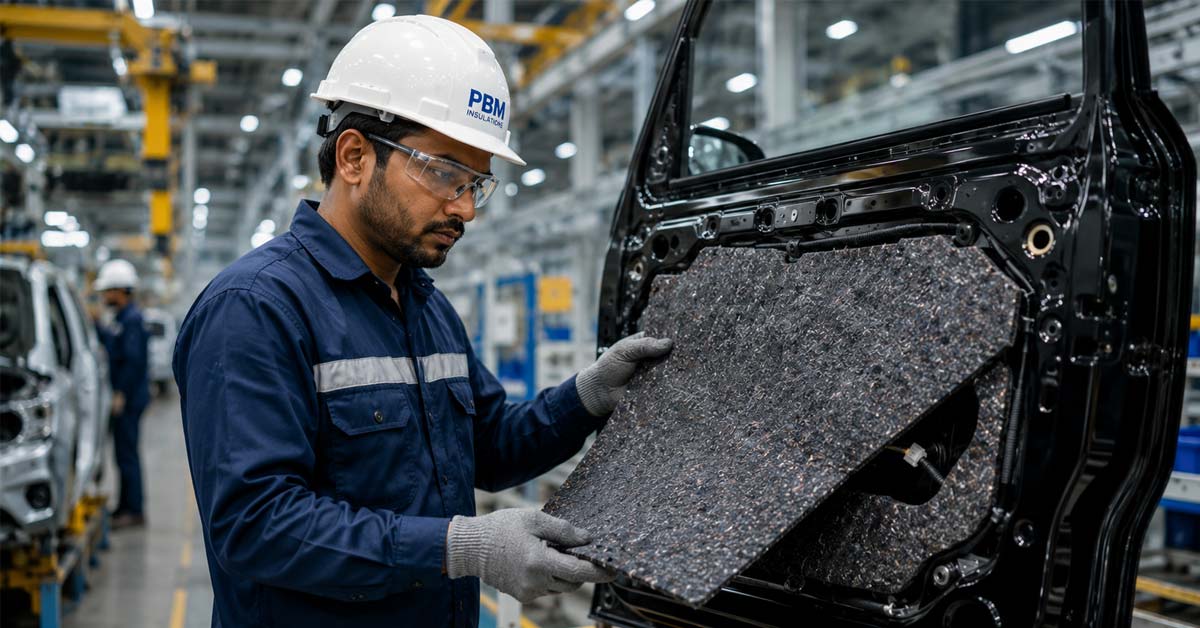
Modern vehicle platforms are placing greater emphasis on cabin refinement. Buyers now judge quality by how a cabin sounds and feels. This has exposed noise paths across doors, floors, dashboards, and underbody structures that once received less engineering attention. As a result, automotive sound insulation has moved from a finishing detail to a core specification in OEM programs.
At PBM Insulations, we have manufactured thermal and acoustic insulation for more than 30 years. Our work spans OEM qualification, in-house validation, and production consistency across passenger and commercial vehicle platforms. That experience has taught us one thing clearly: acoustic performance is won or lost in how a material behaves at scale, not on a test bench.

The real problem is rarely the noise itself. It is holding the same acoustic performance from prototype approval to full production volume. A material that passes a single sample can still drift once it enters high-volume supply. When that happens, the cost surfaces late.
This is where disciplined automotive sound insulation matters. This article explains how cabin noise and vibration control shapes OEM programs, what makes insulation materials effective, and how Resin Bonded Mats, Synthalon Felt, and Hybrid Mats support consistent NVH performance at scale.
Why Cabin Noise and Vibration Control Matters in Automotive OEM Programs
Noise and vibration are no longer comfort features. They are measurable targets tied to brand perception, validation gates, and warranty exposure across every modern vehicle program.
Where Noise and Vibration Enter the Cabin
Cabin noise reaches occupants through two paths. Airborne noise travels through gaps and panels. Structure-borne noise travels through the vehicle structure, transferring vibration from one component to another before it reaches the cabin. Doors, floors, dashboards, and the underbody are the main entry zones. Each surface carries a different mix of sound and vibration. Each cabin zone behaves differently, which means one material alone rarely delivers complete acoustic control. Engineers must map each zone and match the right insulation to it. When one zone is left weak, the entire refinement target slips.
The Impact of Uncontrolled NVH on OEM Vehicle Programs
Poor NVH performance rarely stays quiet. It shows up in customer complaints, lower quality scores, and warranty claims. Worse, it often appears late, during validation, when design freedom has narrowed. At that stage, fixes mean added mass, tooling changes, and production rework. Each change adds cost and delays the program. The lesson is simple. Acoustic decisions made early protect both the timeline and the budget. Early material selection also helps OEM teams maintain automotive NVH targets throughout validation and production.
Controlling noise and vibration early is not a comfort upgrade. It is a program safeguard. This is why OEMs are building acoustic insulation into design, not adding it after.
Understanding Automotive Sound Insulation Materials and Their Role
Automotive sound insulation works by controlling how sound and vibration move through a vehicle. Effective automotive sound insulation supports cabin noise reduction by controlling both airborne and structure-borne noise paths. It manages transmission, damps vibration, and fits the space it is built for.
What Makes Automotive Sound Insulation Effective
The value of any acoustic material comes from how it balances performance with real-world fitment. Four properties define this.
- Sound Transmission Reduction: Limits how much airborne noise passes through panels and gaps into the cabin.
- Vibration Damping: Reduces structure-borne noise by absorbing energy before it reaches occupants.
- Lightweight Integration: Delivers acoustic control without adding mass that works against efficiency targets.
- Custom Fitment: Conforms to complex shapes and confined spaces where standard parts do not fit.
Automotive Sound Insulation Applications Across Vehicle Systems
Acoustic requirements change from one zone to the next. A material tuned for one surface may underperform on another.
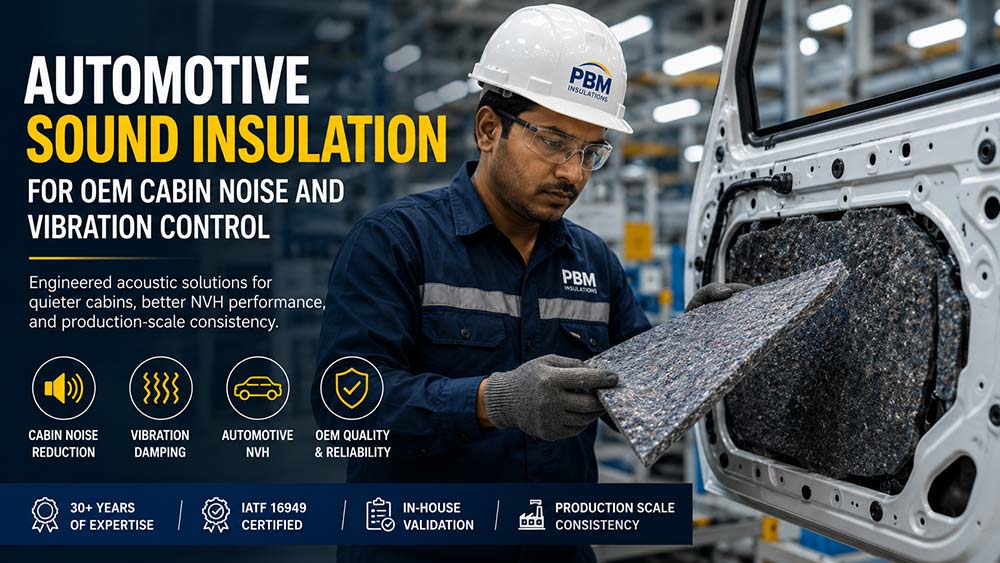
- Doors: Reduce road and wind noise entering through door cavities and seals.
- Floors: Block underbody noise and damp vibration from the road surface.
- Dashboards: Reduce sound transmission from the front-end structure and engine bay into the vehicle interior.
- Underbody Systems: Shield the cabin from tyre, road, and drivetrain noise.
- Engine Bulkhead: Control noise transfer between the powertrain and the cabin.
Because each zone behaves differently, acoustic insulation is a system, not a single part. This is where OEM acoustic insulation systems prove their worth.
Acoustic Insulation Materials Used in Automotive NVH Systems
Selecting the right material is where acoustic strategy becomes real. The right choice depends on the zone, the noise type, and the volume the program demands.
Selecting Materials for Automotive Acoustic Performance
PBM’s Resin Bonded Mats, Synthalon Felt, and Hybrid Mats are built to hold performance from prototype to production. Each material serves a defined role.
- Resin Bonded Mats: Lightweight and non-combustible, engineered to reduce sound transmission across panels.
- Synthalon Felt: A dense felt, built in the 800–1600 gsm range, for anti-vibration and sound absorption in high-demand zones.
- Hybrid Mats: Combine acoustic and thermal properties in one part, tailored to program-specific needs.
- Multi-Layer Acoustic Assemblies: Stack materials to control several noise paths within a single packaging limit.
- Application-Specific Material Combinations: Matched to the exact fitment and performance target of each vehicle zone.
Which Materials Are Used for Automotive Sound Insulation?
Automotive sound insulation commonly uses resin bonded mats, synthalon felt, hybrid mats, and multi-layer acoustic assemblies. Each is chosen by noise type, packaging space, weight target, and the durability the application demands.
At PBM, this selection is backed by real capability. Custom fitment, in-house validation, and IATF 16949 manufacturing systems ensure that prototype performance carries through to full-scale production.
Benefits of Automotive Sound Insulation in OEM Programs
For OEMs, the value of automotive sound insulation is measured in outcomes, not features. The right system protects comfort, quality, and program stability at scale.
- Cabin Noise Reduction: Delivers the quieter cabin buyers now expect across the vehicle lineup.
- Vibration Damping: Controls structure-borne noise for a smoother, more refined ride.
- Production-Scale Consistency: Holds the same acoustic result across thousands of units, not just samples.
- Custom Fitment Across Systems: Matches doors, floors, dashboards, and underbody with purpose-built parts.
- Large-Scale Supply Readiness: Supports high-volume programs with reliable, on-time supply.
These are the outcomes that decide whether an acoustic system succeeds in the field. Consistency at volume is what separates a supplier from a partner.
Conclusion
Cabin refinement is now a specification, not an afterthought. Uncontrolled noise and vibration cost OEMs in quality scores, warranty, and late-stage rework. Automotive sound insulation controls that risk when it is engineered early and proven at scale. PBM’s acoustic portfolio — resin bonded mats, synthalon felt, and hybrid mats — is built to hold insulation performance from prototype to production.
For OEMs building quieter, more refined platforms, PBM combines 30+ years of manufacturing, IATF 16949-certified systems, and in-house validation.
Contact PBM to discuss custom OEM acoustic solutions for doors, floors, dashboards, and underbody systems across prototype, validation, and production programs.
Ready to Future-Proof Your Product with Insulation That Performs?
At PBM Insulations, we engineer thermal and acoustic solutions that power India’s leading OEMs. Whether you’re building the next electric vehicle, optimizing industrial machinery, or looking to enhance sustainability — we’re here to co-create with precision, trust, and performance.
Let’s turn your insulation challenges into engineered solutions.
📩 Reach out for a custom consultation
🌐 Visit us at: www.pbminsulations.com
📞 Call us: +91-7310777959
🔗 Connect with us: LinkedIn | YouTube | Instagram
Join our network for monthly insights on insulation innovation, EV breakthroughs, and industry trends. Subscribe to PBM Insulation Insights today.
“Crafting Quiet Strength Since 1993” | An IATF, ISO & Ecovadis Certified Company | Your OEM Partner in Thermal & Acoustic Innovation