

Margin erosion after SOP is one of the most persistent and least understood threats to manufacturing margins. Industry studies indicate that 60 to 70 percent of cost overruns in complex OEM programs originate from early design and validation assumptions, not from late-stage operational failure. Yet most teams begin investigating only after profitability has already started slipping.

Products often enter production with healthy commercial projections. Volumes rise. Performance meets targets. Still, margins quietly compress. This erosion rarely stems from a dramatic breakdown. Instead, it develops through a series of small insulation decisions and design approvals made long before SOP, when scale realities were not fully stress-tested.
In complex EV, defence, and industrial platforms, prototype-optimised insulation design can lock in recurring labour minutes, material waste, and engineering change impact. Once embedded, these factors influence long-term production cost stability.
At PBM Insulations, with three decades of experience as an OEM insulation supplier, we have seen how early insulation planning shapes lifecycle program profitability. This article reframes margin erosion as a design-enabled commercial risk, not merely an operational symptom.
How Insulation Decisions Influence Production Cost Stability
Early insulation decisions influence production cost stability because they shape how efficiently a product can be built at scale, not just how well it performs in validation builds. When insulation design is optimised for prototype approval rather than volume production efficiency, hidden cost friction becomes embedded into daily operations.
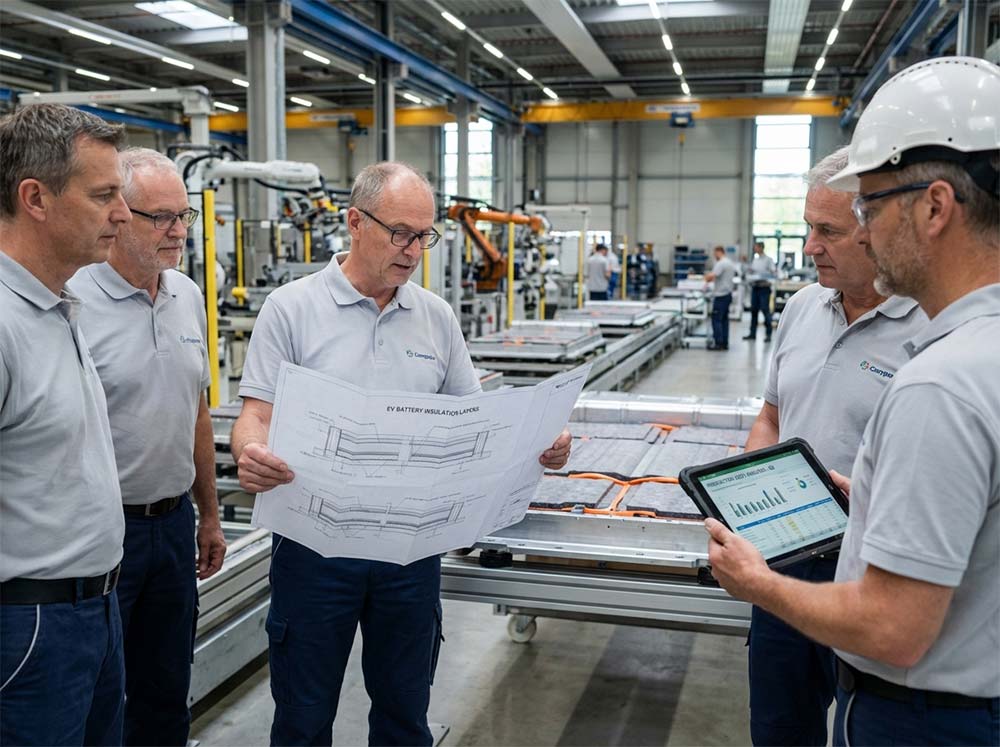
From Prototype Approval to Production Reality
Margins rarely collapse the moment SOP is achieved. Most programs enter production believing the hardest commercial work is already behind them. Yet insulation-related inefficiencies often begin compounding quietly at this stage. Minor fit challenges, handling complexity, or tolerance sensitivity may seem manageable in pilot builds but scale differently in full production.
Why does this rarely trigger immediate concern?
Because the financial impact is distributed. Extra labour minutes, trimming waste, and rework cycles accumulate gradually without disrupting output. Over time, however, these embedded inefficiencies weaken production cost stability and reduce lifecycle program profitability.
Stronger insulation planning and early manufacturing scale validation can prevent this erosion before it becomes structurally locked into the program.
Why Early Insulation Design Creates Hidden Post SOP Costs
Early insulation design decisions often create hidden post SOP costs because they are validated for technical compliance, not long-term production cost stability. When insulation design lacks manufacturing scale validation, small inefficiencies become embedded and difficult to reverse once production begins.
Insulation-Related Costs Feel Invisible at First
Hidden post SOP costs rarely appear as a single spike. Instead, they spread across multiple cost heads and operational layers, making early escalation unlikely.
Before teams recognise the structural issue, cost drift is already underway.
- Distributed cost increases: Small additions across labour, rework, scrap, and overhead dilute visibility and delay response.
- Operational normalisation: Early margin pressure is accepted as production stabilisation rather than linked to insulation design.
- Delayed financial visibility: Finance identifies erosion months before engineering sees a technical signal.
What Gets Blamed Instead of Insulation Design Gaps?
Post SOP costs are frequently attributed to external variables. However, upstream insulation planning gaps often remain unexamined.
Misdiagnosis prolongs production cost instability.
- Supplier performance: Variability is blamed even when insulation design tolerances drive inconsistency.
- Labour efficiency: Extra minutes are tracked but not traced to design complexity.
- Ramp-up learning curves: Teams expect costs to self-correct despite structural inefficiencies.
When insulation decisions are not evaluated through a commercial lens, hidden post SOP costs quietly compound and weaken lifecycle program profitability.
Insulation Design Gaps Between Prototype Validation and Manufacturing Scale
Insulation design gaps emerge when prototype validation confirms performance and compliance, but manufacturing scale validation remains incomplete. Engineering teams focus on thermal targets, safety standards, and packaging fit, while finance evaluates unit economics and production cost stability. The disconnect between these functions allows insulation decisions to move forward without fully assessing long-term lifecycle program profitability.
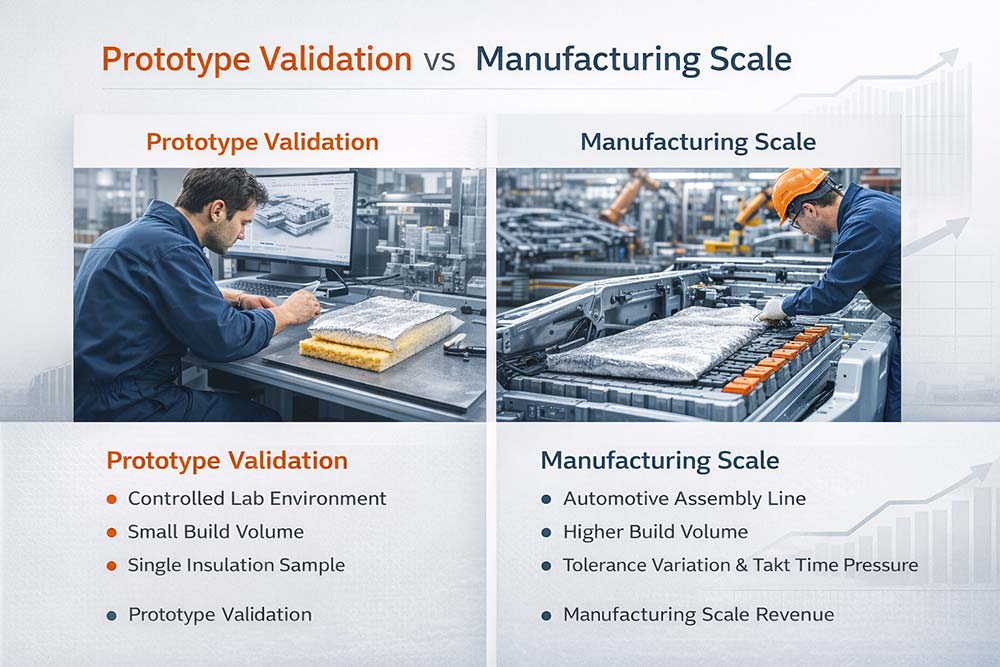
The Gap Between Prototype Approval and Volume Production Efficiency
The gap typically appears when insulation design assumptions approved under controlled builds are not stress-tested for repeatability at full production volumes. Installation that works smoothly in pilot runs may behave differently when operators rotate, takt time tightens, and volume production efficiency becomes critical. Design for manufacturability is often assumed rather than measured.
Why Do Early Insulation Decisions Carry More Commercial Weight Than Expected?
Because insulation is treated as a technical component rather than a commercial lever. Once insulation design is locked, engineering change impact increases sharply. Post SOP costs then reflect earlier decisions that lacked scale visibility.
When OEM insulation planning does not integrate manufacturing scale validation, insulation decisions quietly shape production cost stability for the entire program lifecycle.
Where Insulation Planning Breaks Down in OEM Programs
OEM insulation planning often breaks down when prototype validation is mistaken for manufacturing scale validation. Insulation is assessed for thermal performance, regulatory compliance, and packaging fit. These checks are necessary, but they do not fully address production cost stability or volume production efficiency.
From Prototype Validation to Recurring Post SOP Costs
The breakdown begins when insulation design approved in pilot builds is not stress-tested for repeatability at scale. Controlled builds rely on skilled teams and limited volumes. Design for manufacturability and operator variability receive less attention.
An insulation solution that performs well in early builds can still introduce hidden post SOP costs once volumes increase. Additional labour minutes, minor rework cycles, and material waste accumulate gradually. Each unit absorbs a small inefficiency. Over thousands of units, production cost stability weakens and lifecycle program profitability narrows.
Why Insulation-Driven Margin Loss Escapes Early Escalation
Insulation-related friction rarely halts production. It spreads across labour, scrap, and overhead without triggering a single cost spike. Symptoms appear localised rather than systemic.
In long-lifecycle EV, hydrogen, and defence programs, these small inefficiencies compound over years. When OEM insulation planning does not integrate manufacturing scale validation, insulation decisions quietly shape long-term commercial performance.
Why Correcting Insulation Decisions After SOP Is Commercially Expensive
Correcting insulation decisions after SOP is commercially expensive because production systems are optimised for stability, not redesign. Once volumes begin, any change to insulation design affects tooling, supplier agreements, takt time, and quality validation. What appears to be a minor technical adjustment often carries a wider engineering change impact across the program.
The True Cost of Post SOP Insulation Corrections
Post SOP costs increase sharply because insulation modifications disrupt established production cost stability. Tooling may require rework. Fixtures and handling processes may need adjustment. Supplier renegotiation can affect pricing, lead times, and approvals. Even small material changes introduce line instability and new variability.
These ripple effects extend beyond engineering. They influence volume production efficiency and lifecycle program profitability.
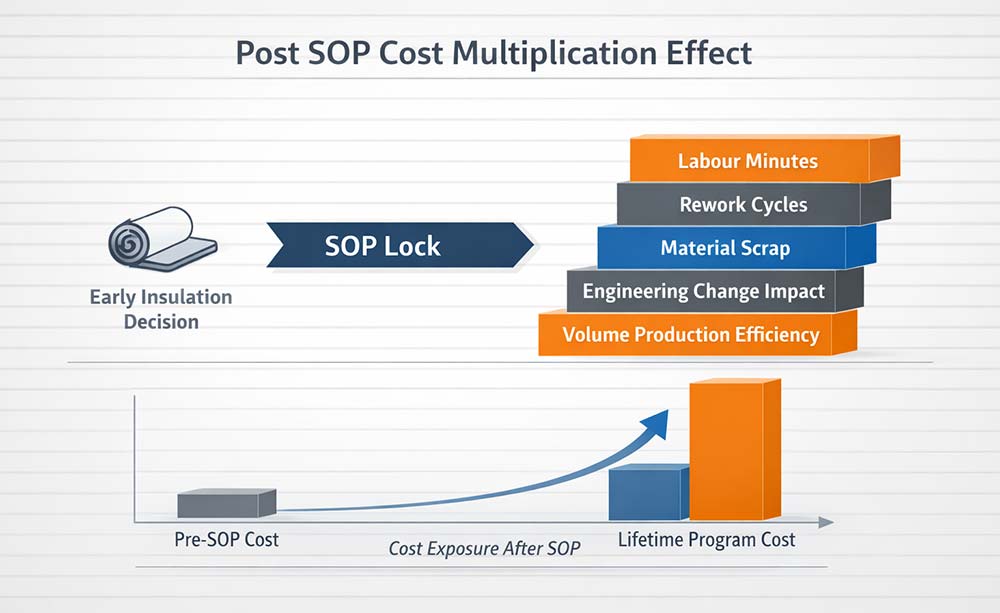
One-Time Engineering Fix or Long-Term Cost Exposure?
Leadership teams often approve insulation corrections assuming the impact is contained to a single action. In reality, the financial effect compounds across every unit produced.
Why is the lifetime impact underestimated?
Because per-unit thinking hides scale. A few additional minutes or minor material cost differences seem manageable until multiplied across thousands of units and long program timelines.
Once insulation decisions are corrected late, commercial flexibility narrows and production cost stability becomes harder to restore.
Insulation Decisions as a Lever for Lifecycle Program Profitability
Insulation decisions influence lifecycle program profitability because they shape production cost stability long before SOP. When evaluated commercially, they prevent recurring post SOP costs from embedding into long-term OEM manufacturing programs.
- Cross-functional validation: Engineering, manufacturing, and finance align before insulation decisions are locked, ensuring cost ownership and design intent reflect lifecycle commercial realities.
- Scale-focused testing: Manufacturing scale validation confirms design for manufacturability under real takt time, operator variation, and volume production efficiency constraints.
- Early risk visibility: Post SOP costs, engineering change impact, and tolerance sensitivity are identified before they compromise production cost stability.
- Commercial insulation planning: OEM insulation supplier collaboration ensures insulation design supports long-term lifecycle program profitability, not just prototype approval.
Post SOP margin reviews repeatedly show that early insulation decisions define long-term cost behaviour. Treating insulation as a strategic commercial lever strengthens lifecycle program profitability and reduces downstream engineering change exposure.

Final Words
Post SOP margin erosion is rarely the result of one visible mistake. It is the cumulative impact of insulation decisions made early, validated under prototype conditions, and never re-tested for manufacturing scale validation. These assumptions quietly influence production cost stability for the entire lifecycle of the program.
For long-lifecycle EV, hydrogen, and defence platforms, insulation design must support volume production efficiency and lifecycle program profitability from the start. Once SOP is achieved, engineering change impact increases and commercial flexibility narrows.
Programs that treat insulation decisions as a strategic upstream lever, not a downstream technical detail, protect margins more effectively and build long-term manufacturing resilience.
OEM leaders, engineering heads, and procurement teams evaluating insulation decisions at scale can engage with PBM Insulations to strengthen production cost stability and lifecycle program profitability. Reach out to discuss insulation planning aligned with manufacturing scale and long-term commercial performance.
Ready to Future-Proof Your Product with Insulation That Performs?
At PBM Insulations, we engineer thermal and acoustic solutions that power India’s leading OEMs. Whether you’re building the next electric vehicle, optimizing industrial machinery, or looking to enhance sustainability — we’re here to co-create with precision, trust, and performance.
Let’s turn your insulation challenges into engineered solutions.
📩 Reach out for a custom consultation
🌐 Visit us at: www.pbminsulations.com
📞 Call us: +91-7310777959
🔗 Connect with us: LinkedIn | YouTube | Instagram
Join our network for monthly insights on insulation innovation, EV breakthroughs, and industry trends. Subscribe to PBM Insulation Insights today.
“Crafting Quiet Strength Since 1993” | An IATF, ISO & Ecovadis Certified Company | Your OEM Partner in Thermal & Acoustic Innovation